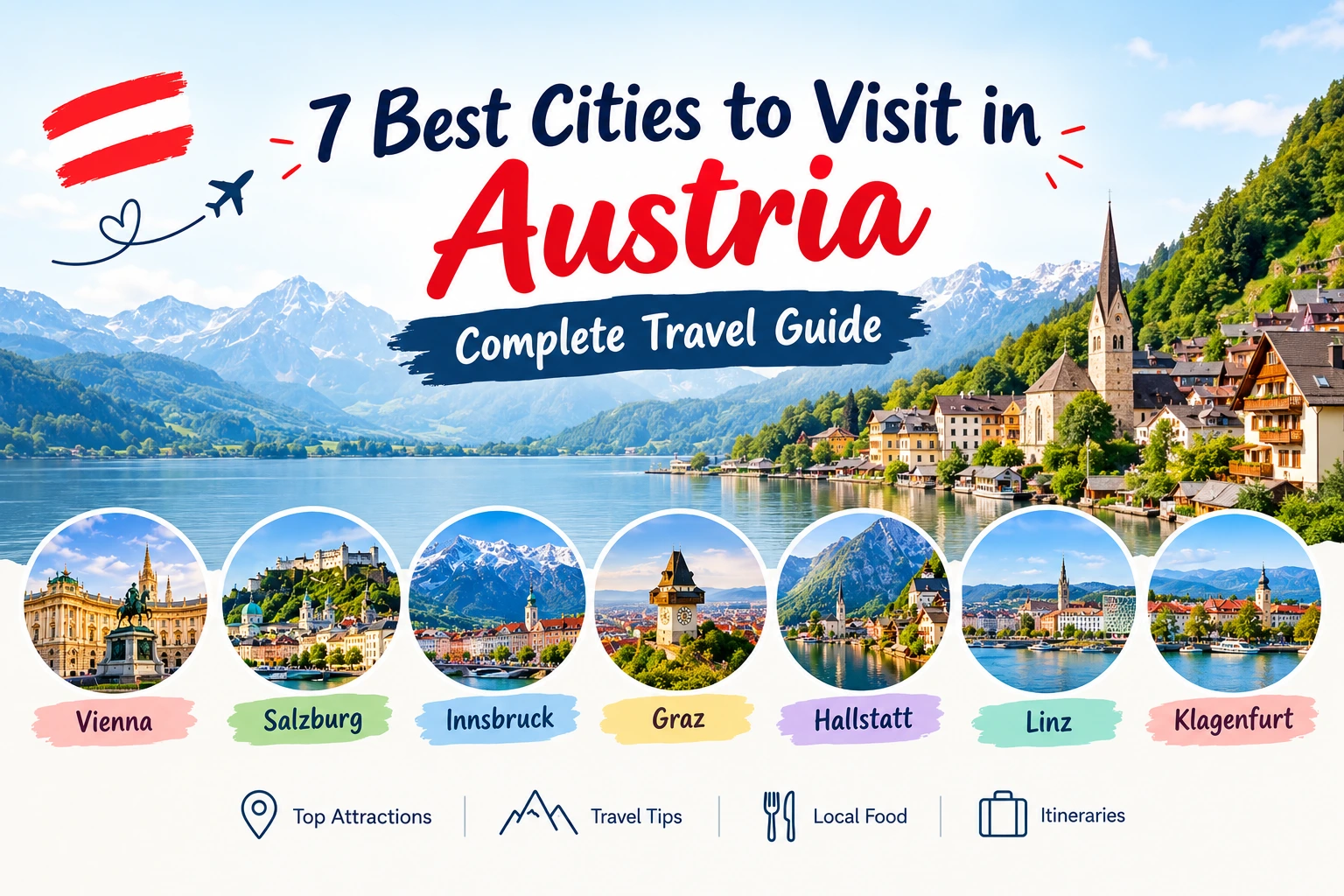
Austria packs royal palaces, snow-covered mountains, and warm swimming lakes into one small country. That variety makes it an exciting place to visit. However, it also makes trip planning tricky. First-time visitors often book too many stops without checking how long it takes to cross the Austrian Alps.
The 7 best cities to visit in Austria are Vienna for imperial palaces and museums, Salzburg for baroque architecture and music history, Innsbruck for high-mountain cable cars, Graz for southern food and wine, Linz for modern digital art along the Danube, Klagenfurt for warm summer lake life, and Bregenz for lakeside opera near the Swiss and German borders.
You do not need to visit all seven on a single holiday. This guide breaks down what to see in each city, how many days to stay, and the smartest ways to travel between them whether you are planning a family vacation, a romantic trip for two, or a solo adventure.
Quick Summary: The 7 Best Cities to Visit in Austria
Use this summary table to compare Austria’s top cities by travel style, ideal trip length, and travel time from the capital.
City | Region / State | Best For | Ideal Stay | Top Cultural or Natural Highlight | Travel Time from Vienna (Train / Road) |
1. Vienna | Vienna (Wien) | First-time visitors, families, couples, museum lovers | 3–4 days | Schönbrunn Palace, Hofburg & St. Stephen’s Cathedral | Starting hub (25–35 mins from Vienna Airport) |
2. Salzburg | Salzburgerland | Couples, music fans, historic old town walks | 2–3 days | Hohensalzburg Fortress & Mozart’s Birthplace | ~2h 20m by train / ~3h 00m by car (296 km) |
3. Innsbruck | Tyrol (Tirol) | Mountain lovers, winter sports, active travelers | 2–3 days | Nordkette Cable Car & The Golden Roof | ~4h 15m by train / ~4h 45m by car |
4. Graz | Styria (Steiermark) | Foodies, wine lovers, relaxed sightseeing | 2 days | Schlossberg Clock Tower & Historic Old Town | ~2h 35m by train / ~2h 15m by car |
5. Linz | Upper Austria | Families, tech & modern art fans, route stopovers | 1–2 days | Ars Electronica Center & Danube Riverfront | ~1h 15m by train / ~2h 10m by car |
6. Klagenfurt | Carinthia (Kärnten) | Summer lake holidays, families, swimmers | 2 days | Lake Wörthersee & Minimundus Miniature Park | ~3h 20m by train / ~3h 30m by car |
7. Bregenz | Vorarlberg | Opera fans, modern architecture, lake cruises | 1–2 days | Lake Constance Floating Stage & Pfänder Peak | ~6h 40m by train (closer to Zurich & Munich) |
1. Vienna: The Best City in Austria for Imperial Palaces and Museums
Vienna (Wien) is Austria’s capital and largest city. For centuries, it served as the home of the Habsburg emperors, who ruled a large part of Europe. You can see that royal history everywhere along the Ringstraße, a grand boulevard that circles the historic First District (Innere Stadt). Despite its grand buildings, Vienna is clean, safe, and easy to explore on foot or by subway (U-Bahn).
Top Attractions and Activities in Vienna
Schönbrunn Palace (Schloss Schönbrunn): The former summer home of the royal family has 1,441 rooms and wide baroque gardens (a formal, highly decorated 17th- and 18th-century European style). Families love visiting the Tiergarten Schönbrunn, the oldest zoo in the world, located right inside the palace park.
The Hofburg and St. Stephen’s Cathedral (Stephansdom): In the heart of the old town, the Hofburg Palace houses the Sisi Museum and the Spanish Riding School, where famous white Lipizzaner horses perform. A ten-minute walk brings you to St. Stephen’s Cathedral, known for its colorful tiled roof.
Belvedere Palace and MuseumsQuartier: Art lovers should visit the Upper Belvedere to see Gustav Klimt’s famous golden painting, The Kiss. For modern art and outdoor cafés, head to the MuseumsQuartier.
Traditional Viennese Coffeehouses: Vienna’s café culture is listed by UNESCO as an intangible cultural heritage. Sit down for a Melange (steamed milk and espresso, similar to a cappuccino) and a slice of apple strudel (Apfelstrudel).
Ideal Visit Duration and Transport Tips
Plan 3 to 4 full days in Vienna so you do not have to rush through the palaces.
Most international travelers land at Vienna International Airport (VIE) in Schwechat, located about 18 kilometers southeast of the city center. Regional trains (the S7 and ÖBB Railjet) and the City Airport Train (CAT) connect the airport to major city stations in 15 to 25 minutes. However, train stations still require you to carry your bags onto a subway, tram, or taxi to reach your hotel. If you are arriving after a long flight with children or heavy suitcases, booking a pre-arranged Vienna airport transfer for direct hotel pickup takes you straight from the arrivals hall to your accommodation door in 25 to 35 minutes.
2. Salzburg: One of the Most Beautiful Cities in Austria
Sitting on the northern edge of the Austrian Alps right next to the German border, Salzburg is famous as one of the most beautiful cities in Austria. The fast-moving Salzach River splits the city in two, with a medieval fortress sitting high on a cliff above church domes and narrow cobblestone lanes.
Top Attractions and Activities in Salzburg
Hohensalzburg Fortress: Built in 1077, this is one of the largest preserved medieval castles in Europe. You can walk up the steep path or take the FestungsBahn funicular (a short cable railway that pulls cars up a steep slope) for views of the city and the surrounding mountains.
Historic Old Town (Altstadt) and Getreidegasse: Salzburg’s old center is a UNESCO World Heritage site. Walk down Getreidegasse, a narrow shopping street with traditional wrought-iron shop signs, to see Mozart’s Birthplace at No. 9.
Mirabell Palace and Gardens: Built in 1606 across the river, these free public gardens offer views right back up to the fortress. Fans of the 1965 movie The Sound of Music will recognize the Pegasus fountain and stone steps from the "Do-Re-Mi" song.
Café-Konditorei Fürst: Stop at this historic bakery on Brodgasse to try the original handmade Mozartkugela round chocolate treat filled with pistachio marzipan and dark nougat, first created here in 1890.
Ideal Visit Duration and Transport Tips
Stay 2 to 3 days in Salzburg. Day-trip crowds fill the old town between 10:00 AM and 4:00 PM, so sleeping overnight lets you enjoy the quiet streets in the early morning and evening.
Salzburg is about 296 kilometers west of Vienna. Direct trains from Vienna Main Station (Wien Hauptbahnhof) take around 2 hours and 20 minutes. By road along the A1 motorway, the journey takes about 3 hours. Many families and small groups prefer traveling by road so they can stop at Melk Abbey in the Wachau Valley or visit the lakeside village of Hallstatt along the way without worrying about train station luggage lockers.
3. Innsbruck: The Best Place to Visit in Austria for Alpine Views
Located in the western state of Tyrol (Tirol), Innsbruck sits in a wide valley surrounded by the high peaks of the Austrian Alps. It is the best city in Austria for travelers who want to combine historic buildings with easy mountain adventures.
Top Attractions and Activities in Innsbruck
Nordkette Cable Car: You do not need to be a climber to reach the top of the Alps here. Starting from the Congress station in the city center, the Hungerburgbahn funicular and Nordkette cable cars lift you up to the Hafelekar peak (2,256 meters above sea level) in about 20 minutes.
The Golden Roof (Goldenes Dachl): In the middle of Innsbruck’s medieval old town, this famous balcony was built in 1500 for Emperor Maximilian I and is covered in 2,657 shiny gold-plated copper tiles.
Imperial Palace (Hofburg) and Court Church (Hofkirche): Right next to the old town, the Hofkirche holds 28 giant black bronze statues guarding the emperor’s empty tomb.
Bergisel Ski Jump: Designed by architect Zaha Hadid, this modern ski jump tower on the south side of town has a viewing platform and café overlooking the whole valley.
Ideal Visit Duration and Transport Tips
Allow 2 to 3 days in Innsbruck. Buy the Innsbruck Card (valid for 24, 48, or 72 hours) if you plan to ride the Nordkette cable car and visit two or more museums the pass includes the cable car ticket and public buses, which saves money quickly.
4. Graz: A Popular City in Austria for Food, Wine, and Culture
Set south of the main mountain range in the green state of Styria (Steiermark), Graz is Austria’s second-largest city. Because it sits on the southern side of the Alps, Graz enjoys milder weather, sunny squares, and red-tiled roofs that look almost Italian. It is officially known as Austria’s Culinary Capital (GenussHauptstadt).
Top Attractions and Activities in Graz
Schlossberg and the Clock Tower (Uhrturm): A tree-covered hill rises right in the middle of the city. Take the glass elevator inside the rock or climb the steps to see the Uhrturm, a 16th-century clock tower where the big hand shows the hours and the small hand shows the minutes. Kids and adults can ride the Schlossbergrutschea tall indoor metal slideback down.
Kunsthaus Graz and the Murinsel: Next to its UNESCO-protected old town, Graz loves modern architecture. The Kunsthaus is a blue, bubble-shaped art museum locals call the "Friendly Alien," while the Murinsel is a steel shell floating like an island in the Mur River.
Styrian Armoury (Landeszeughaus): The largest historic armoury in the world displays 32,000 original suits of armor, swords, and helmets from the 1500s and 1600s.
Farmers' Markets and Pumpkin Seed Oil: Visit the morning market at Kaiser-Josef-Platz to taste fresh local apples, regional white wines, and Styrian pumpkin seed oil (Kürbiskernöl)a rich, dark-green oil drizzled over salads and soups.
Ideal Visit Duration and Transport Tips
Spend 2 days in Graz. From Vienna, driving takes about 2 hours and 15 minutes down the A2 motorway, while the train takes around 2 hours and 35 minutes over the scenic Semmering mountain pass.
5. Linz: A Must-Visit City in Austria on the Danube River
Located in Upper Austria along the Danube River, Linz sits roughly halfway between Vienna and Salzburg. Once known mainly for steel factories, Linz transformed itself into a UNESCO City of Media Arts that blends baroque squares with interactive science and digital art museums.
Top Attractions and Activities in Linz
Ars Electronica Center: Known as the "Museum of the Future," this hands-on museum lets visitors test robotics, artificial intelligence exhibits, and Deep Space 8Ka huge room where laser projections cover both the walls and the floor.
Main Square (Hauptplatz) and Pöstlingbergbahn: Starting from one of the largest enclosed squares in Europe, board the Pöstlingbergbahn mountain tramway for a steep 20-minute climb up to the hilltop basilica and family-friendly fairytale grotto railway (Grottenbahn).
Lentos Art Museum and Mural Harbor: Walk along the Danube at night when the glass Lentos Museum glows in neon colors, or take a boat tour through Mural Harbor to see over 300 giant street-art paintings on cargo buildings.
Taste a Slice of Linzer Torte: Stop at a local bakery like Konditorei Jindrak to try Linzer Torte. Made with a nut crust and redcurrant jam under a lattice top, its written recipe from 1653 makes it the oldest named cake in the world.
Ideal Visit Duration and Transport Tips
Linz is great for 1 to 2 days, or even as a 4-hour lunch and museum stopover while traveling between Vienna and Salzburg. Fast trains connect Vienna to Linz in 1 hour and 15 minutes, while driving takes about 2 hours and 10 minutes via the A1 motorway.
6. Klagenfurt: The Best Place in Southern Austria for Warm Lakes
In Austria’s southernmost state of Carinthia (Kärnten), near the borders of Italy and Slovenia, Klagenfurt sits on the eastern shore of Lake Wörthersee. Because the high Alps block cold northern winds, Lake Wörthersee is one of the warmest alpine lakes in Europe, with summer water temperatures reaching up to 27°C (80°F).
Top Attractions and Activities in Klagenfurt
Lake Wörthersee and Strandbad Klagenfurt: Spend a summer day swimming from the wooden piers at the historic lakeside bathing beach (Strandbad), renting a pedal boat, or riding a passenger ferry across the turquoise water to lakeside towns like Maria Wörth and Velden.
Minimundus: Located near the lakeshore, this outdoor park displays more than 150 famous buildings from around the world built at a 1:25 miniature scale. It is one of the best stops in southern Austria for families with children.
Alter Platz and the Lindwurm Fountain: Walk through Klagenfurt’s pedestrian old town to see Renaissance courtyards and the 16th-century Lindwurm Fountain, a stone statue of a winged dragon from local legend.
Pyramidenkogel Observation Tower: A short drive above the lake brings you to the tallest wooden viewing tower in the world (100 meters high), offering views across the lakes and the Karawanks mountain range.
Ideal Visit Duration and Transport Tips
Plan 2 days in Klagenfurt (or longer in July and August for a relaxed summer beach holiday). Thanks to the Koralmbahn high-speed railway tunnel, direct trains connect Graz and Klagenfurt in just 42 minutes, cutting the total train ride from Vienna down to about 3 hours and 20 minutes.
7. Bregenz: Lakeside Opera and Mountain Views on Lake Constance
In the far western state of Vorarlberg, Bregenz rests on the shores of Lake Constance (Bodensee), right where Austria, Germany, and Switzerland meet. Because of its western location, Bregenz is actually closer to Zurich and Munich than to Vienna, making it a smart stop for travelers connecting Austria with Switzerland or southern Germany.
Top Attractions and Activities in Bregenz
Bregenz Festival Floating Stage (Seebühne): Every July and August, the Bregenzer Festspiele stages grand operas on a huge outdoor platform built directly into the water of Lake Constance. Even when no show is running, you can walk along the lakeside promenade to see the stage up close.
Pfänderbahn Cable Car: Ride this smooth cable car from near the lakeshore up to the 1,064-meter Pfänder mountain. On a clear day, you can look across the lake and see up to 240 mountain peaks across three countries, plus a free alpine wildlife park for kids.
Kunsthaus Bregenz (KUB) and vorarlberg museum: Vorarlberg is famous across Europe for modern wood-and-glass architecture. Both waterfront museums showcase sleek design alongside regional history and modern art.
Upper Town (Oberstadt) and Martinsturm: Walk ten minutes uphill from the lake into the quiet medieval quarter to climb St. Martin’s Tower, topped with a large wooden onion dome.
Ideal Visit Duration and Transport Tips
Stay 1 to 2 days in Bregenz. From the harbor, passenger boats cross Lake Constance to the German island town of Lindau in 20 minutes, and trains or private cars easily connect Bregenz with Innsbruck (about 2 hours and 30 minutes via the Arlberg mountain tunnel) or Zurich Airport (about 1 hour and 30 minutes).
How to Travel Around Austria: Trains, Rental Cars, and Private Transfers
Austria has reliable railways and well-maintained highways. The best way to travel between cities depends on your group size, luggage, and whether you want to visit smaller towns along the way.
1. When to Take the Train
High-speed trains operated by ÖBB (Austrian Federal Railways) and WESTbahn are ideal for solo travelers and couples with light bags traveling directly between major city centers like Vienna, Linz, Salzburg, Graz, and Innsbruck. If you book 3 to 6 weeks in advance, discounted Sparschiene tickets are very affordable, though walk-up flexible tickets on the day of travel cost more.
2. When to Rent a Car (And What to Watch Out For)
Renting a car gives you freedom if you plan to spend several days exploring remote mountain valleys in Tyrol or lakeside villages in Carinthia. However, keep three local rules in mind:
Highway Toll Stickers (Vignette): Every vehicle using Austrian motorways (marked with an "A" or "S") must have a valid digital or windshield Vignette before entering the highway, plus extra toll payments for certain alpine tunnels and mountain passes.
Winter Tire Rules: From November 1 to April 15, winter tires are legally required whenever snow, slush, or ice is on the road.
City Parking: Historic old towns in Vienna, Salzburg, and Graz have strict short-term parking rules (Kurzparkzonen) and expensive garage rates.
3. When a Private Chauffeur Transfer Makes the Most Sense
If you are traveling as a family with children, a small group of 3 to 7 people, or a couple carrying multiple suitcases, changing between trains, regional buses, and station platforms can be tiring. Using a Vienna-based private chauffeur and transfer service lets you travel directly from your hotel lobby in one city to your hotel door in the next.
With pre-booked private city-to-city transfers across Austria, your fare is fixed in advance and already covers highway tolls, parking fees, pre-installed child seats, and space for large suitcases or ski gear. Better yet, you can turn a travel day between Vienna and Salzburg into a relaxed sightseeing route by asking your driver to stop at Melk Abbey, Linz, or Hallstatt while your bags stay safely inside the vehicle.
Sample Itinerary Ideas: How Many Days Do You Need in Austria?
Do not try to pack every city into one short trip. Pick a route that matches your vacation length:
5 to 7 Days (The First-Timer Classic): Spend 3 to 4 nights in Vienna and 2 to 3 nights in Salzburg. On the travel day between the two cities, stop in Linz, the Wachau Valley, or Hallstatt.
10 Days (Cities and High Alps): Follow the 7-day route above, then continue west for 3 nights in Innsbruck to ride the mountain cable cars and explore Tyrol (flying home from Innsbruck or Munich).
10 Days (The Southern Food & Lake Loop): Spend 4 nights in Vienna, travel south for 2 nights in Graz to explore the wine country, continue to Klagenfurt for 2 nights on Lake Wörthersee, and finish with 2 nights in Salzburg.
Frequently Asked Questions (FAQs)
What are the top 3 best cities to visit in Austria for first-time visitors?
Vienna, Salzburg, and Innsbruck are the top three cities for first-time visitors. They sit along a single east-to-west route and cover Austria’s main highlights: Vienna for grand imperial palaces and museums, Salzburg for a walkable baroque old town and music heritage, and Innsbruck for dramatic views of the Austrian Alps.
Which city in Austria is better to visit: Vienna or Salzburg?
Vienna is better if you want big-city energy, world-famous art museums, royal palaces, and historic coffeehouses over a 3- to 4-day stay. Salzburg is better if you want a smaller, romantic old town surrounded by green hills and alpine lakes that you can explore on foot in 2 days. Because they sit only 2.5 to 3 hours apart, most visitors include both on the same trip.
Can you visit the best cities in Austria without renting a car?
Yes. You can easily explore inside Vienna, Salzburg, Innsbruck, Graz, and Linz on foot or by local trams and subways. Between cities, you can either take direct intercity trains or book a door-to-door private transfer which gives you the comfort and sightseeing stops of road travel without having to drive on unfamiliar mountain roads or hunt for parking.
What is the best time of year to visit Austria’s cities?
May to June and September to October are the best months for sightseeing, walking tours, and wine tasting, with mild weather and fewer crowds.
July and August are ideal for swimming in Lake Wörthersee (Klagenfurt) and Lake Constance (Bregenz), or attending summer music festivals in Salzburg and Bregenz.
Late November to December is magical for traditional Christmas markets in Vienna, Salzburg, and Innsbruck, while January to March is peak season for winter skiing around Innsbruck and Tyrol.
Conclusion: Planning Your Austrian Trip
Choosing which of the 7 best cities to visit in Austria belong on your itinerary comes down to what you enjoy most. Start with Vienna and Salzburg for a classic mix of royal history and baroque beauty, head west to Innsbruck and Bregenz for high mountains and lakeside culture, or go south to Graz and Klagenfurt for sunny courtyards, local wine, and warm summer lakes. Pick two or three main cities as your hotel bases, leave room for a scenic stopover in Linz or the alpine lake district, and choose the transport optiontrain, rental car, or private chauffeur that lets your group travel comfortably at your own pace.
WHY TRAVELLERS CHOOSE TOURLYTRANSFER
See What Real Travellers Say About TourlyTransfer
★★★★★ 5.0 on Google MapsBefore you book a Vienna airport transfer or private chauffeur service, discover authentic feedback from passengers who travelled with TourlyTransfer.