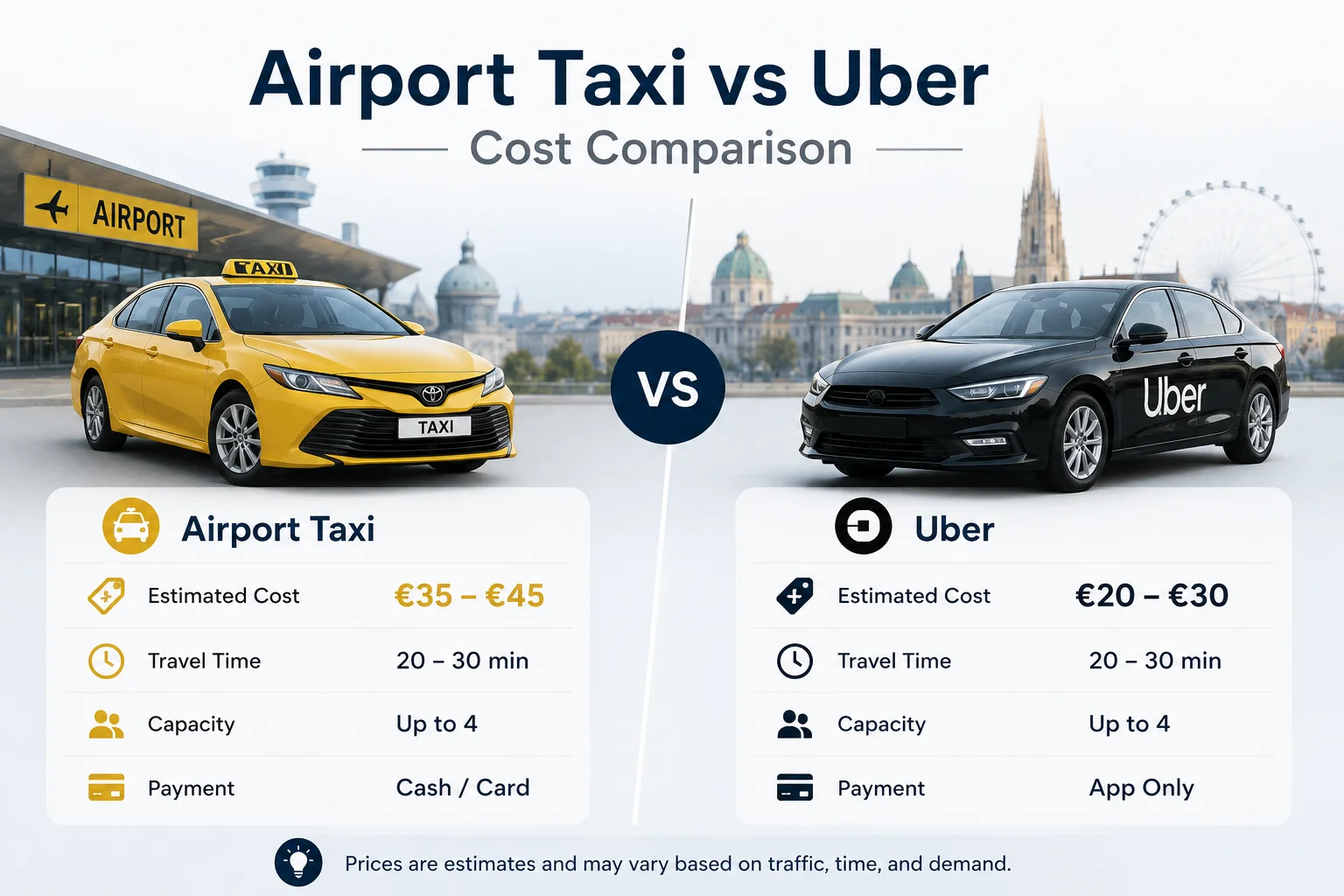
A ride from Vienna International Airport (VIE) to the Vienna city center typically costs €45 to €60+ in a metered walk up airport taxi, €37 to €42 when you prebook a local radio taxi with a fixed airport fare, €32 to €55+ on Uber or Bolt depending on live demand, and starts from €55 for a fixed price Vienna airport transfer with inside terminal Meet and Greet service.
When comparing a Vienna Airport taxi vs Uber vs private transfer in 2026, the lowest initial quote on an app is not always the final price you pay. Because Vienna International Airport is located in Schwechat in Lower Austria just outside the official Vienna city tariff zone, travelers often face return surcharges on metered cabs, strict luggage limits, or upstairs pickup walks at Terminal 3.
This guide compares real 2026 prices, terminal pickup rules, vehicle sizes, and ride apps so you can book the best option for your trip.
Vienna Airport Taxi vs Uber vs Private Transfer at a Glance
Before booking your ride from Vienna Airport, compare how the main transport options differ in price, pickup convenience, and luggage space:
| Transport Option | Typical 2026 Cost to City Center | Pricing Model | Terminal 3 Pickup Point | Luggage & Group Capacity | Best For |
| Walk Up Airport Taxi | €45 to €60+ | Taximeter plus Lower Austria return fee | Ground floor outside Arrivals Hall | Up to 3 guests and 2 to 3 suitcases | Solo travelers wanting an immediate walk up cab |
| Prebooked Radio Taxi (40100 / 31300) | €37 to €42 | Fixed only if requested as an Airport Fare | Designated City Transfer counter or curb | Up to 3 guests and 2 suitcases | Local residents familiar with Austrian taxi dispatch rules |
| Uber / Bolt / FreeNow | €32 to €45 (Standard) €50 to €75+ (XL or Surge) | Dynamic live app pricing | Upstairs on Departures level bridge | 2 suitcases in UberX 3 suitcases in UberXL | Solo travelers or couples with light bags during quiet hours |
| Private Airport Transfer (TourlyTransfer) | Fixed from €55 (Route & vehicle dependent) | Guaranteed flat rate locked in at booking | Inside Arrivals Hall with a name board | Business Sedan (2 bags) or V Class Van (up to 7 guests & 7 bags) | Families, international tourists, business travelers, and groups |
How Vienna Airport Taxi Pricing Works
Vienna has a regulated taxi system where official cars display TX license plates and a roof sign. However, Vienna International Airport sits in the neighboring state of Lower Austria outside the municipal city boundary. That boundary creates two very different taxi prices:
Metered Walk Up Taxis (€45 to €60+): If you walk out of the Arrivals Hall and enter a standard taxi at the rank without agreeing on a flat airport rate first, the driver runs the taximeter plus a mandatory return fee of around €18 to cover the drive back to the Vienna city limit. Heavy traffic on the A4 motorway will increase the metered total.
Prebooked Radio Taxis (€37 to €42): Local dispatchers such as Taxi 31300 and Taxi 40100 offer fixed airport rates. When calling or ordering through their apps, you must specifically request the Airport Fare (Flughafentarif) before dispatch. Without that request, the standard meter and return surcharge apply.
When is a Vienna Airport taxi a good choice?
You are traveling alone or as a couple with one or two standard suitcases.
You want to walk out of the terminal without booking ahead.
You confirm the flat rate with the driver before loading your bags.
Using Uber, Bolt, FreeNow, and Lyft at Vienna Airport
Many international visitors open their phone after landing to check ride apps. Here is how app based rides work at Vienna Airport in 2026.
Does Lyft Work in Vienna or Should I Use Something Else?
Lyft does not operate in Vienna or anywhere in Austria. Travelers from the United States who normally use Lyft have two reliable alternatives at Vienna International Airport:
For a Fixed Rate and Terminal Meet and Greet: Book a private car in advance with TourlyTransfer so a licensed chauffeur tracks your flight and meets you inside the Arrivals Hall.
For On Demand App Rides: Download Uber, Bolt, or FreeNow, which are the three active ride apps in Vienna.
Which App Is Better for Airport Pickups in Vienna: Uber or FreeNow?
Both Uber and FreeNow work well in Vienna because Austrian law requires ride apps to dispatch licensed local taxi and private hire fleets:
Uber and Bolt: Convenient if you already have the app installed with a saved payment card. Standard daytime rides (UberX) to central Vienna usually cost €32 to €45, while larger vehicles (UberXL or Van) cost €50 to €75+.
FreeNow: Connects directly with official Vienna taxis through an English mobile app, letting drivers use dedicated taxi lanes across the city.
Three Things to Know Before Booking Uber at Vienna Airport
Upstairs Pickup Walk at Terminal 3: Standard Uber and Bolt drivers do not pick up at the ground floor Arrivals curb. Passengers at Terminal 3 typically have to take the elevator upstairs to the Departures level curb across the bridge or walk into the multi story car park.
Luggage Restrictions: Standard UberX vehicles fit about two large suitcases, and UberXL vehicles fit about three suitcases. If a group of four arrives with four large bags and cabin luggage, a standard driver can refuse the pickup.
Peak Hour Surge Pricing: When several international flights land at once or bad weather hits Vienna, live app fares climb quickly.
For a broader look at getting around the city during your trip, read our comparison of chauffeur vs taxi vs Uber in Vienna.
Why Travelers Prefer a Prebooked Private Airport Transfer
A private transfer focuses on certainty, comfort, and time saved at the airport. While a solo traveler with a backpack might save a few Euros on an off peak app ride, families, business travelers, and groups of three to seven passengers often get far better value from a reserved vehicle.
Booking a Vienna airport transfer with TourlyTransfer includes:
Meet and Greet in Arrivals: Your chauffeur waits inside the arrivals hall holding a name board, assists with your luggage, and walks you directly to your reserved Mercedes Benz.
Live Flight Monitoring and 60 Minutes Free Waiting Time: Your flight number is tracked automatically. Whether your plane lands early or is delayed, your pickup time adjusts at no extra cost and includes 60 minutes of complimentary waiting time after landing.
Guaranteed Vehicle Size for Bags and Families: Choose an executive Mercedes Benz E Class or S Class (up to 3 guests and 2 bags), an all electric Mercedes Benz EQS, or a spacious Mercedes Benz V Class Business Van (up to 7 guests and 7 bags).
Preinstalled Child Safety Seats: Traveling with infants or young children? Request sanitized, age appropriate child seats or boosters during booking. Learn more in our guide to booking a Vienna Airport transfer with a child seat.
Late Night Arrivals, Business Travel, and Direct City to City Transfers
Early Morning and Late Night Flights
When your flight lands after midnight or departs at 5:00 AM, waiting for an available app driver adds unnecessary stress. A prebooked chauffeur guarantees your car is waiting outside your hotel or terminal on schedule. Read our Vienna Airport taxi at night guide for complete late arrival tips.
Business Travel and Hourly Chauffeur Hire
Executives attending meetings in the Innere Stadt or conferences at the Austria Center Vienna often need flexible transport across multiple stops. Alongside direct airport pickups, you can reserve a dedicated driver by the hour (3 hour minimum, starting from €52 per hour for a Business Sedan) through our chauffeur service in Vienna.
Direct Transfers from Vienna Airport to Nearby Cities
If you are heading straight from Vienna Airport to a neighboring country, local taxis and ride apps charge steep per kilometer rates. You can book direct, fixed price cross border transfers with zero train changes:
Vienna to Bratislava transfer: Around 1 hour drive, fixed price from €120.
Vienna to Budapest transfer: Around 2.5 hours drive, fixed price from €495.
Vienna to Prague transfer: Around 3.5 hours drive, fixed price from €513.
Which Vienna Airport Transfer Option Should You Choose?
Choose a Vienna Airport Taxi if: You want to walk out of the terminal without booking ahead, have only one or two bags, and confirm the fixed airport rate before getting in.
Choose Uber, Bolt, or FreeNow if: You are traveling light during quiet daytime hours and do not mind walking upstairs to the Terminal 3 Departures curb to meet your driver.
Choose a Private Transfer if: You want a guaranteed fixed price from €55, an English speaking chauffeur waiting inside the Arrivals Hall with a name sign, 60 minutes of free waiting time, child seats, or a Mercedes Benz van that fits up to 7 passengers and 7 suitcases.
Frequently Asked Questions
How much does Uber cost from Vienna Airport to the city center in 2026?
A standard UberX from Vienna International Airport to central Vienna typically costs between €32 and €45 during off peak hours. If you need an UberXL or Van for extra luggage or arrive during busy flight times, live prices usually rise to €50 to €75+.
Is a taxi or Uber cheaper from Vienna Airport?
For one or two travelers with small bags during quiet periods, Uber or Bolt (€32 to €45) is often slightly cheaper than a prebooked radio taxi (€37 to €42) and noticeably cheaper than a metered walk up taxi (€45 to €60+). For families, business travelers, or groups with several suitcases, a prebooked private transfer offers better value because the rate is fixed in advance with no hidden fees.
Does Lyft work in Vienna and what is the best alternative at Vienna Airport?
No, Lyft does not work in Vienna or Austria. If you want an on demand ride app, use Uber, Bolt, or FreeNow. If you prefer a guaranteed flat rate with a driver waiting inside the terminal, book a private transfer with TourlyTransfer.
Where do you meet Uber drivers at Vienna Airport Terminal 3?
At Terminal 3, rideshare drivers normally pick up passengers one level above Arrivals on the Departures curbside bridge or in designated parking garage zones. By contrast, a prebooked TourlyTransfer chauffeur meets you directly inside the Arrivals Hall right after baggage claim.
Why do Vienna Airport taxis charge an extra return fee?
Vienna Airport is located in Schwechat in the state of Lower Austria, outside the Vienna municipal boundary. Metered city taxis add a return surcharge of about €18 unless you prebook a specific flat airport tariff. Booking a fixed price private transfer eliminates meter charges and return fees completely.
Book Your Fixed Price Vienna Airport Transfer
Skip the taxi lines, surprise meter fees, and upstairs pickup walks. Reserve your Vienna airport transfer online in under two minutes or visit TourlyTransfer to explore our Mercedes Benz fleet, hourly chauffeur hire, and private city to city routes across Central Europe.