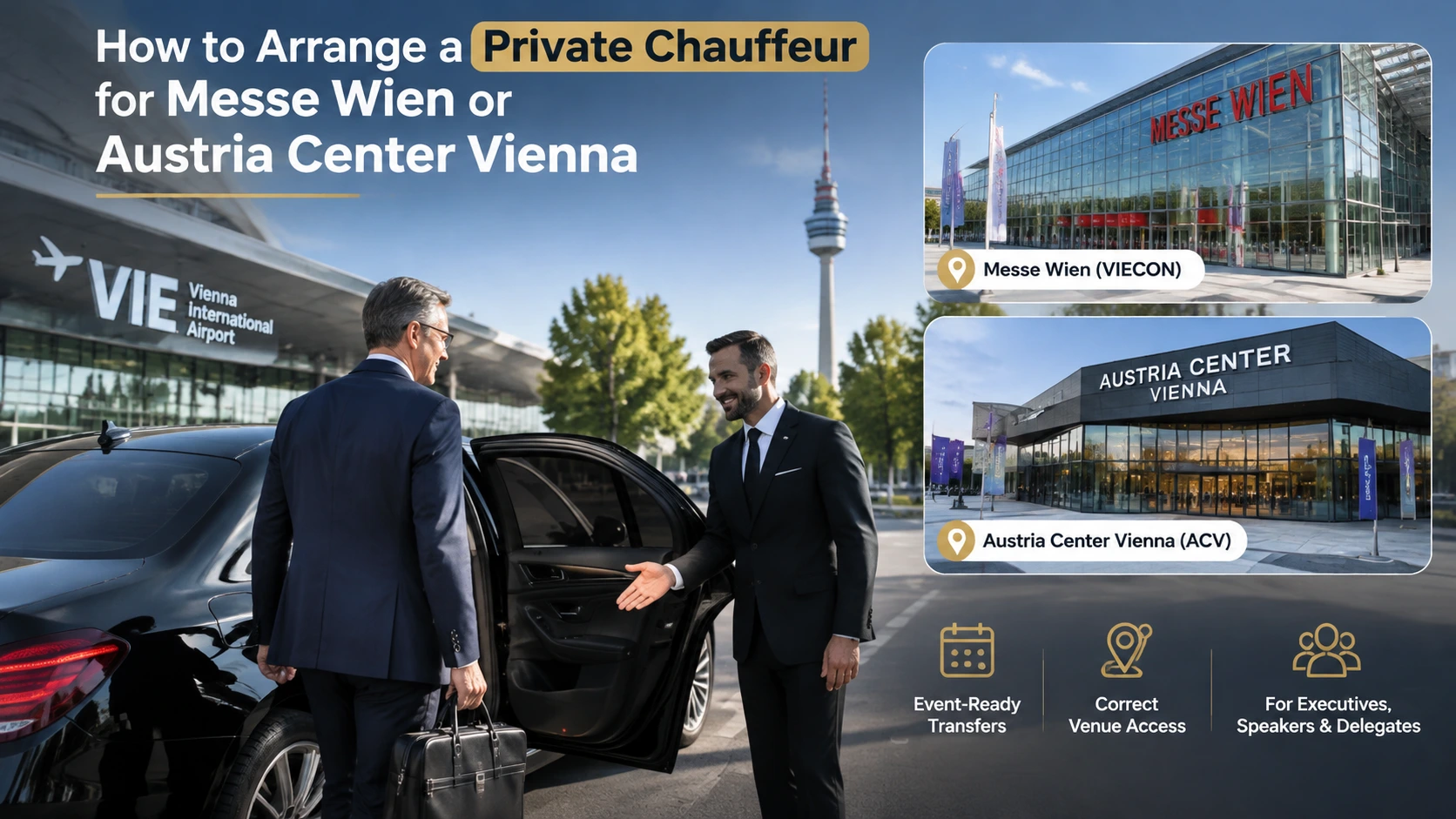
Arranging a private chauffeur for a Vienna conference takes more than supplying a venue address. The passenger needs the correct entrance, the vehicle needs an approved access point, and the return collection must be agreed in advance.
Messe Wien (VIECON) and Austria Center Vienna (ACV) have different layouts and access rules. This guide explains what to confirm when arranging a chauffeur for yourself, an executive, a speaker or a group of delegates.
1. Confirm the Exact Venue, Hall and Passenger Entrance
Start with the event confirmation. Check the event name, venue, hall, foyer and entrance. The address identifies the complex; the organiser’s instructions identify the passenger’s destination.
Messe Wien (VIECON): Foyer A or Foyer D?
Messe Wien, also known as VIECON – Vienna Congress & Convention Center, is at Messeplatz 1, 1020 Vienna.
VIECON identifies two main visitor approaches: Foyer A, generally associated with Halls A and B and the Congress Center, and Foyer D, generally associated with Halls C and D.
VIECON recommends checking the event website because the correct entrance depends on the event location. “Messe Wien” alone may not tell the chauffeur which side of the complex the passenger needs. Follow the organiser’s current instructions, and do not assume the pedestrian entrance is also an approved vehicle stopping point.
Austria Center Vienna: Identify the Correct Entrance
Austria Center Vienna is at Bruno-Kreisky-Platz 1, 1220 Vienna, beside the Vienna International Centre.
The building has several entrances. Its official Level 0 guide identifies Entrance 1 as the main ground-level entrance, Entrance 2 as the route towards the Level 1 Loft Area, and Entrance 3 as a convenient entrance for Halls E and F. These are pedestrian-navigation details, not confirmation of chauffeur access. Confirm the passenger entrance and permitted vehicle approach separately.
Before sending a booking request, record the full venue name, event date, hall or foyer, and the passenger entrance specified by the organiser.
Official venue references: VIECON visitor FAQs and Austria Center Vienna arrival information.
2. Passenger Drop-Off Is Not the Same as Vehicle Access
This is a critical distinction: a passenger may need Foyer A, Foyer D or a particular Austria Center entrance, but that does not automatically mean a private vehicle can stop at that door or enter the event grounds.
What to check at Messe Wien
VIECON lists a taxi stand in front of Foyer A. However, a taxi stand should not be treated as automatic permission for every pre-booked private chauffeur to use the same stopping or waiting area.
VIECON’s published house rules state that general parking is prohibited across the property except in designated parking areas and specified long-term spaces. They also set conditions for event loading and unloading, and restrict vehicle use on event traffic routes during visitor opening hours.
Do not promise a direct foyer drop-off. Confirm the permitted access point with the organiser or venue. If direct access is not authorised, agree on a suitable legal meeting point outside the restricted area.
What to check at Austria Center Vienna
Austria Center Vienna publishes road approaches via the A22 and the Austria Center Vienna/VIC exit, as well as approaches from the Reichsbrücke and Wagramer Straße. It also has on-site parking facilities.
These routes explain how to approach the complex, but do not establish a universal chauffeur drop-off bay. Ask the organiser for the event entrance, vehicle instructions and designated collection point.
Confirm these four details
| Question | What needs confirmation |
|---|---|
| Where is the passenger going? | Exact hall, foyer or entrance |
| Where may the vehicle stop? | Organiser- or venue-approved point |
| Can the vehicle wait? | Parking permission and duration |
| Where is the return pickup? | Agreed collection point, not just the venue address |
This prevents a passenger being directed to the wrong side of the complex or relying on an unverified stopping arrangement.
3. Plan the Airport-to-Conference Journey Around the Schedule
For a passenger arriving at Vienna International Airport (VIE), decide whether to travel directly to the venue or stop at the hotel first. A direct journey may suit a delegate with an imminent event; a hotel stop may be better for check-in, changing or presentation preparation.
Align three times:
The flight’s scheduled arrival.
When the passenger is expected to be ready to leave the airport or hotel.
When they must reach the event entrance.
Do not plan around the conference start time alone: registration, badge collection and the walk from the vehicle point may take additional time. For a fixed presentation or client appointment, work backwards from the commitment and allow a realistic buffer. Avoid promising an exact road journey time without checking the date and time.
Keep the booking brief together: passenger name, flight details, destination, event date, entrance instructions and the contact for updates. Confirm airport meeting and waiting arrangements separately in the guide to Vienna Airport transfer arrangements; this article focuses on venue access.
4. Different Conference Roles Need Different Journey Briefs
The venue may be the same, but the passenger’s role can change the arrival instructions.
Executives and invited clients
An executive may have a private meeting, a host at a designated entrance or a business dinner afterwards. Identify the receiving contact, event entrance and fixed appointments. Use one person to communicate itinerary changes so the chauffeur does not receive conflicting instructions.
Speakers and presenters
Plan a speaker’s arrival around the presentation schedule. They may need a speaker desk, technical check or separate accreditation before reaching the session room. Ask the organiser whether speakers use the same entrance as delegates and include any separate check-in point.
Exhibitors and stand representatives
Exhibitors may carry samples, presentation cases or other materials, but passenger access and freight access must not be confused.
At VIECON, the published house rules distinguish ordinary visitor movement from vehicle access for event loading and unloading. Deliveries and stand construction should follow the organiser’s exhibitor manual and venue logistics instructions. A passenger chauffeur booking is not a substitute for a freight arrangement.
Establish whether the passenger carries personal luggage, portable presentation items or materials requiring a separate delivery process.
5. Coordinate Group Arrivals Without Mixing Up Instructions
When a company sends several delegates, speakers or clients, one generic venue address is rarely enough. Guests may arrive on different flights, stay at different hotels or attend separate sessions, so the plan should reflect their actual destinations and schedules.
Prepare a passenger movement sheet with:
Passenger or group name.
Arrival date and flight, where relevant.
Hotel or starting address.
Event hall and entrance.
Approved vehicle drop-off point.
Required arrival time.
Return collection point.
One person authorised to communicate changes.
Assign one coordinator to maintain the latest schedule and share changes to the hall, entrance or event time with the provider and affected passengers.
For multi-passenger or multi-vehicle arrangements, the event and group transportation information explains the details needed to plan coordinated journeys. This article focuses on venue-specific access; the service page covers the wider event transport arrangement.
6. Confirm the Return Collection Before the Conference Ends
Plan the return at the same time as the arrival. Large venues may use several exits, and the passenger may leave from a different foyer. A vehicle may also be unable to wait in a restricted area.
Before the event, agree:
The exact exit or meeting point.
Whether the vehicle can legally stop or wait there.
The expected finish time and any flexibility.
Who will tell the chauffeur when the passenger is ready.
The next destination, such as a hotel, restaurant or Vienna Airport.
What the passenger should do if the event overruns or the meeting point changes.
For an executive with several appointments, the final collection may form part of a wider business itinerary. The page about corporate chauffeur arrangements in Vienna covers the broader business travel service; this guide deals with the specific access and collection details at the conference venues.
7. The Conference Chauffeur Brief: A Ready-to-Use Checklist
Before the booking is confirmed, make sure the provider has the information needed to plan the venue-specific part of the journey.
| Booking field | Information required |
|---|---|
| Venue | Messe Wien / VIECON or Austria Center Vienna |
| Event | Official conference or exhibition name |
| Date | Event date and arrival date |
| Passenger role | Delegate, speaker, executive or exhibitor |
| Event area | Hall, foyer or entrance from organiser |
| Vehicle access | Confirmed permitted drop-off point |
| Arrival deadline | Time passenger must reach the event |
| Event contact | Name and reachable contact method |
| Return collection | Confirmed exit and meeting point |
| Next destination | Hotel, meeting location or airport |
| Special instructions | Approved access, mobility or equipment requirements |
Compare the event registration details with the transport brief. If the hall or entrance changes, update the chauffeur instructions. Recheck the current venue rules and follow event-specific instructions over assumptions based on a general map.
Frequently Asked Questions
Can a private chauffeur drop me directly at Messe Wien Foyer A?
VIECON lists a taxi stand in front of Foyer A, but this does not automatically confirm access for every pre-booked private vehicle. Confirm the permitted passenger drop-off point with the organiser or venue before the journey.
Is Foyer D the correct entrance for every Messe Wien event?
No. VIECON associates Foyer D mainly with Halls C and D, while Foyer A is generally used for Halls A and B and the Congress Center entrance. Follow the entrance stated by your event organiser.
Where should a chauffeur drop passengers at Austria Center Vienna?
The correct vehicle stopping point should be confirmed for the specific event. The venue’s road-access information identifies approaches via the A22/VIC exit and Wagramer Straße, but a road approach is not the same as permission to stop at a particular entrance.
Can the same journey include Vienna Airport, a hotel and the conference venue?
The itinerary can be requested as a sequence of destinations, but the provider must confirm the route, timing and booking terms. State whether the passenger is going directly to the event or needs a hotel stop first.
What should a speaker or VIP guest confirm before the transfer?
Confirm the event entrance, accreditation or speaker check-in location, required arrival time, receiving contact and any separate meeting point. Do not assume that a VIP invitation grants access to a restricted vehicle area.
Can exhibitors use a chauffeur vehicle to deliver stand materials?
A passenger vehicle should not be treated as an exhibition freight vehicle. Check the exhibitor manual and venue logistics instructions for loading access, delivery times and vehicle permissions. Arrange freight separately where required.
Should the return chauffeur use the same point as the arrival?
Not necessarily. The event may use different entrances for departure, and vehicle stopping rules may differ. Confirm the collection point and waiting arrangements before the event begins.
Plan the Venue Access Before You Book the Journey
A well-planned conference chauffeur transfer starts with accurate venue instructions, not simply a street address. At Messe Wien, the event’s Foyer A or Foyer D designation helps identify the passenger entrance, while VIECON’s vehicle rules mean that a private chauffeur should not assume access to event traffic routes. At Austria Center Vienna, the correct event entrance and approved vehicle approach should also be confirmed separately.
Before the journey, make sure the passenger, organiser and provider share the same event area, permitted drop-off, arrival deadline and return point. This preparation reduces confusion and gives the chauffeur a clear itinerary.