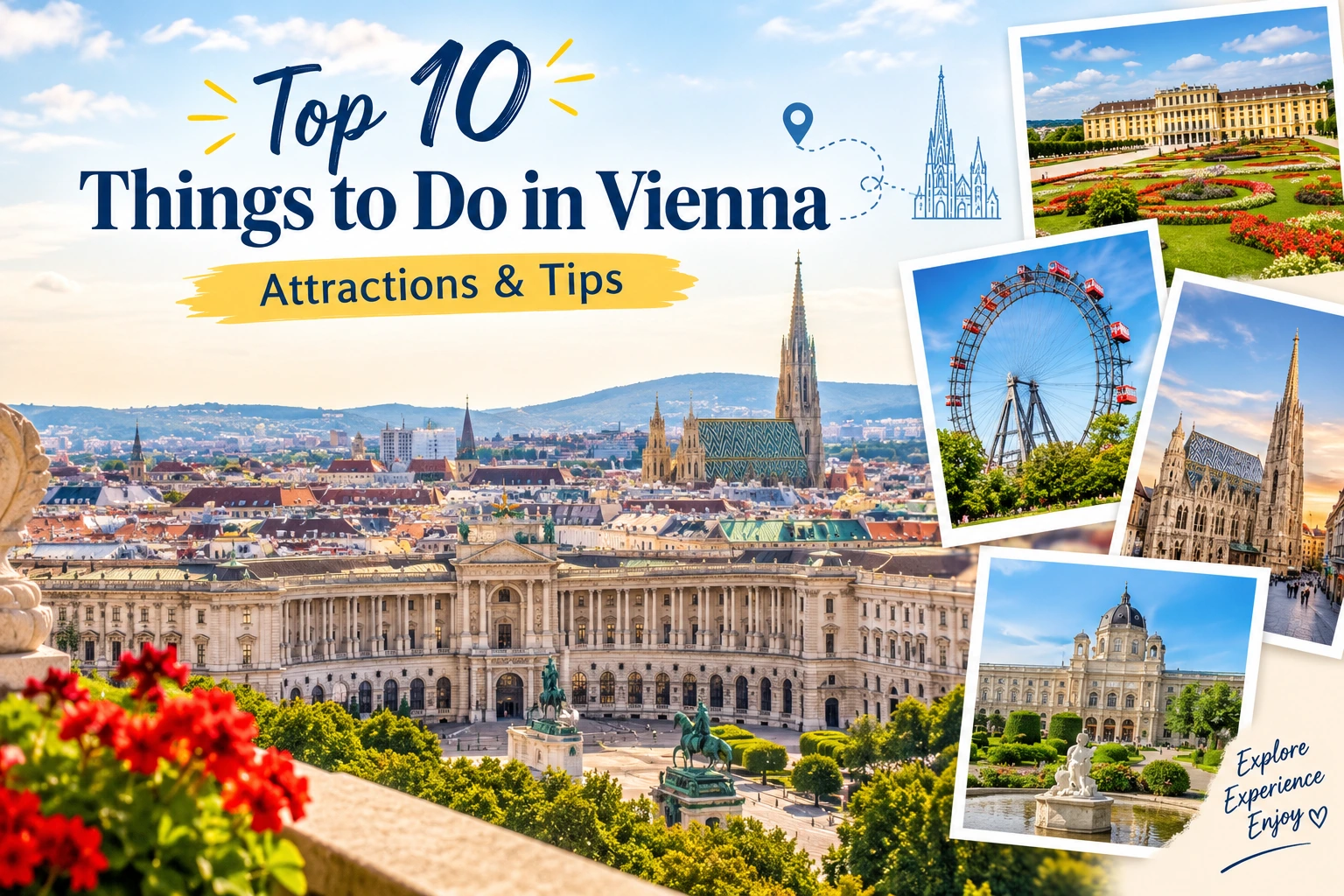
Vienna, Austria’s capital, combines imperial palaces, historic streets, celebrated museums, traditional coffeehouses, and a lively cultural scene. Whether you are visiting for a weekend or including Vienna in a longer European holiday, there are plenty of things to do in Vienna for history lovers, art enthusiasts, foodies, and first-time visitors alike.
Short on time? Start with Schönbrunn Palace, St. Stephen’s Cathedral, Belvedere Palace and a traditional coffeehouse. Together they cover imperial history, the Old Town, Gustav Klimt and Viennese café culture.
This guide covers the top 10 things to do in Vienna, with practical planning tips, suggested itineraries, transport advice, seasonal highlights, and ideas for day trips beyond the city.
1. Explore Schönbrunn Palace
Schönbrunn Palace is one of Vienna’s most recognisable landmarks. Once the summer residence of the Habsburg dynasty, the palace is known for its imperial rooms, grand architecture, and extensive landscaped gardens.
Visitors can choose from available palace tours or spend time exploring the grounds. If you enjoy history and architecture, the palace interiors are a major attraction; if you prefer outdoor sightseeing, the gardens offer space to walk and take photographs.
Best for: History lovers, architecture enthusiasts, and first-time visitors.
Getting there: Take the U4 to Schönbrunn station, a short walk from the palace. Trams 10 and 60 and bus 10A also stop at Schloss Schönbrunn, according to the palace’s how-to-get-here page.
Planning tips:
- Book tickets online ahead during busy periods, and check which ticket covers the rooms you want to see.
- Allow extra time if you want to explore both the palace and gardens.
- Wear comfortable shoes, as the estate involves considerable walking.
- If you would rather not manage transport, TourlyTransfer’s private Vienna sightseeing tour includes Schönbrunn and the Ringstraße with a chauffeur, billed by the hour.
Suggested time: Around 2–4 hours, depending on the areas you visit.
Nearby planning idea: Treat Schönbrunn as a dedicated half-day visit rather than squeezing it between several attractions in the historic centre.
Official visitor information: Schönbrunn Palace visitor information, tickets and opening times
2. Admire the Art at Belvedere Palace
Belvedere Palace combines Baroque architecture, landscaped gardens, and an important art collection. The complex includes Upper Belvedere and Lower Belvedere, with gardens connecting the two areas.
Upper Belvedere is especially well known for Gustav Klimt’s The Kiss. The collection also includes work by Egon Schiele and Vincent van Gogh, making it a worthwhile stop for visitors interested in painting and cultural history.
Best for: Art lovers, museum visitors, and travellers who enjoy historic architecture.
Getting there: Take tram D to Schloss Belvedere for Upper Belvedere. Trams 18 and O stop at Quartier Belvedere.
Planning tips:
- Upper and Lower Belvedere are visited with a time-slot ticket, so book online and check your slot before you go.
- Check which exhibitions are running and what your ticket includes.
- Leave time to explore the gardens and enjoy the palace exterior.
- Decide whether you want to visit one building or explore more of the complex.
Suggested time: Around 1.5–3 hours.
Official website: Belvedere Palace
3. Visit St. Stephen’s Cathedral
St. Stephen’s Cathedral stands in the heart of Vienna’s historic centre and is one of the city’s defining landmarks. Its Gothic architecture, distinctive patterned roof, and prominent towers make it an essential stop for many first-time visitors.
The surrounding streets are also worth exploring. Historic lanes, shops, cafés, and other central sights make it easy to combine the cathedral with a walking tour of the Old Town.
Depending on current visitor arrangements, you can explore the cathedral interior or buy access to the towers, catacombs and cathedral museum. The South Tower climb is 343 steps, while the North Tower has a lift up to the Pummerin bell.
Best for: Architecture enthusiasts, history lovers, and visitors exploring central Vienna on foot.
Getting there: Take the U1 or U3 to Stephansplatz, which is right beside the cathedral.
Planning tips:
- Check admission arrangements for ticketed areas such as the towers and catacombs. Church services take priority, so visiting times can change at short notice.
- Dress respectfully when entering a place of worship.
- Expect busier conditions at popular sightseeing times.
- Allow additional time if you want to explore the surrounding streets.
Suggested time: Around 45–90 minutes, depending on what you visit.
Official website: St. Stephen’s Cathedral
4. Experience Vienna’s Traditional Coffeehouse Culture
Vienna’s coffeehouses are an important part of the city’s cultural identity, and in 2011 Viennese coffeehouse culture was added to UNESCO’s list of intangible cultural heritage. Traditional cafés are associated with elegant interiors, conversation, newspapers, coffee, and pastries. Visiting one is a way to experience a slower side of Vienna between sightseeing stops.
Order a Wiener Melange (a milky coffee, similar to a cappuccino), try a slice of cake, or take a break from walking. Sachertorte is one of Vienna’s best-known desserts, while individual cafés offer their own pastries and specialities. Well-known names include Café Central, Café Sperl (open since 1880), Café Landtmann, Demel and Café Sacher.
Best for: Food lovers, couples, solo travellers, and anyone looking for a relaxed break.
Planning tips:
- Choose a café based on its location and atmosphere. Café Sperl is a good pick if you want a quieter, less touristy setting.
- Visit outside busy meal times if you prefer a quieter setting, as the best-known cafés such as Café Central can have queues.
- Check menu prices before ordering if you are travelling on a budget.
- Nobody will rush you, so allow time to enjoy the visit instead of treating it as a quick stop. Rounding up the bill is the usual way to tip.
Suggested time: Around 45–90 minutes.
For more ideas, browse Vienna Tourism’s guide to traditional coffee houses.
5. Ride the Giant Ferris Wheel at Prater
The Wiener Riesenrad, or Giant Ferris Wheel, is one of Vienna’s best-known attractions and has stood in the Prater since 1897. A ride offers elevated views across the city and provides a different perspective from the historic streets and palace grounds.
The surrounding Prater area includes amusement rides, entertainment, walking paths, and places to eat. You can make a short visit focused on the Ferris Wheel or spend longer exploring the wider recreational area.
Best for: Families, couples, panoramic views, and visitors who enjoy classic attractions.
Getting there: Take the U1 or U2 to Praterstern, then walk a few minutes into the park.
Planning tips:
- The Prater park is free to enter, but the Riesenrad is ticketed separately. Check operating hours, ticket details and the weather before visiting.
- Allow extra time if you want to explore other rides.
- If views are your priority, choose a day with good visibility.
Suggested time: Around 1–2 hours, or longer if you explore more of Prater.
Official website: Wiener Riesenrad
6. Discover Hundertwasser Architecture
Vienna’s architecture is not limited to imperial palaces and grand historic buildings. Hundertwasserhaus offers a colourful contrast, with irregular lines, vivid façades, and greenery incorporated into its distinctive design. It was completed in 1985.
The building is residential, so visitors should admire it from public areas and respect residents’ privacy. The Hundertwasser Village shopping area across the street is open to visitors and was designed in the same style.
Travellers who want to go deeper into the artist’s work can visit Kunst Haus Wien (also known as Museum Hundertwasser), a few minutes’ walk away at Untere Weißgerberstraße 13. It houses the only permanent presentation of Friedensreich Hundertwasser’s work and has reopened after renovation with a new permanent exhibition. Listings show it open daily from 10am to 6pm, and a temporary exhibition, “Seeds. Reclaiming roots, sowing futures,” is listed from April 2026 to February 2027.
Best for: Architecture fans, photographers, and travellers looking for something different from Vienna’s traditional landmarks.
Getting there: Tram 1 to Hetzgasse stops a few metres from Hundertwasserhaus. The nearest U-Bahn stations, Wien Mitte-Landstraße (U3, U4) and Rochusgasse (U3), are a short walk away.
Planning tips:
- Visit during daylight for photographs.
- Do not enter private residential areas or obstruct entrances.
- Check the current exhibition and opening details before visiting Kunst Haus Wien.
Suggested time: Around 30–90 minutes, depending on whether you visit a museum.
Artist and project information: Hundertwasser
7. Explore Naschmarkt
Naschmarkt is one of Vienna’s best-known market areas, with food stalls, restaurants, produce, and a wide range of international flavours. It is a useful stop for travellers who want to explore the city’s food scene beyond traditional Austrian dishes.
Browse the stalls, look for local ingredients, or choose a place to eat. The market runs along the Wienzeile between Karlsplatz and Kettenbrückengasse, and the Saturday flea market sits beside it at the Kettenbrückengasse end, so the day of your visit shapes the experience.
Best for: Food lovers, casual explorers, and visitors interested in market culture.
Getting there: Take the U4 to Kettenbrückengasse, or the U1, U2 or U4 to Karlsplatz at the other end.
Planning tips:
- The market is generally closed on Sundays, although some restaurants may operate. Check the official opening information before you plan your visit.
- Compare prices if you are travelling on a budget, and carry some cash, as produce stalls and flea-market vendors often prefer it.
- Leave enough time to browse instead of arriving just before closing.
Suggested time: Around 45–90 minutes.
Official visitor guide: The Vienna Naschmarkt
8. Attend a Performance at the Vienna State Opera
The Vienna State Opera is a major destination for classical music and opera enthusiasts. Even if you do not attend a performance, the building is worth considering as part of a sightseeing walk through the central city.
If you want to attend an opera, ballet, or another scheduled performance, check the programme for your travel dates. Ticket availability, prices, performance length, and booking conditions vary. Operas are sung in their original languages, and subtitles are available in up to eight languages, including English.
The house also sells standing-room tickets at much lower prices than seats. According to the Opera, a fixed contingent is available for regular evening performances from 80 minutes before the start at the standing-room box office on Operngasse, and standing tickets can also be bought online or at the Bundestheater box office from 10 am on the day of the performance.
Best for: Music lovers, culture enthusiasts, and visitors looking for an evening activity.
Getting there: Karlsplatz station (U1, U2, U4) is a short walk away, and the Ring trams stop at the Oper.
Planning tips:
- Check the official programme before finalising your evening plans.
- Review ticket categories and entry instructions, including how standing tickets are sold.
- Allow enough time to reach the venue, as latecomers may not be admitted to the auditorium.
- Do not assume a performance or lower-priced ticket will be available without checking.
Suggested time: Around 2–4 hours for an evening performance, depending on the programme.
Official website: Vienna State Opera
9. Spend Time at MuseumsQuartier
MuseumsQuartier is a major cultural complex bringing together museums, exhibition spaces, cafés, and public areas. It offers a different perspective on Vienna, with a focus on art, design, contemporary culture, and urban life. The Leopold Museum is its most visited museum, covering Viennese Jugendstil, the Wiener Werkstätte and Expressionism, while mumok focuses on modern and contemporary art.
You can plan a museum visit, stop for a drink, explore the courtyards, or combine the area with nearby central attractions. The best plan depends on which exhibitions interest you and how much time you have.
Best for: Contemporary art enthusiasts, museum visitors, and travellers who want a flexible indoor activity.
Getting there: Take the U2 to MuseumsQuartier, or the U2 or U3 to Volkstheater.
Planning tips:
- Check exhibition schedules and admission arrangements in advance.
- Choose one or two museums rather than trying to see everything in a short visit.
- Leave time to explore the public areas between visits.
Suggested time: Around 1–3 hours, depending on your choices.
Official website: MuseumsQuartier Wien
10. Enjoy the Views from Danube Tower
Danube Tower, known locally as Donauturm, is a popular choice for visitors seeking panoramic views of Vienna. At 252 metres it is the tallest structure in Austria, and its observation platform and revolving restaurant offer a different perspective from the historic centre, particularly when visibility is good.
The tower is outside the immediate cluster of many central landmarks, so account for travel time when planning your day. Check current visitor information for opening hours, ticket details, and any dining options.
Best for: Panoramic views, photography, and travellers who have already explored some central attractions.
Getting there: Take the U1 to Alte Donau or Kaisermühlen-VIC (or the U6 to Neue Donau). From Kaisermühlen-VIC or Alte Donau you can walk through Donaupark, and bus 20A runs from Kaisermühlen-VIC to the tower, according to the tower’s opening-times page.
Planning tips:
- Choose a day with good visibility if views are your main priority.
- Allow for the journey from your accommodation or previous attraction.
- Confirm current access arrangements before travelling.
Suggested time: Around 1–2 hours, excluding travel.
Official website: Danube Tower
Bonus: Consider Visiting Hofburg Palace
If you have extra time, Hofburg Palace is another worthwhile stop. This former imperial complex was the centre of the Habsburg empire until 1918 and includes historic courtyards, the Imperial Apartments, the Sisi Museum and the Spanish Riding School.
Schönbrunn and Hofburg offer different experiences. Schönbrunn is known for its extensive grounds and former summer-residence setting, while Hofburg is closely connected with Vienna’s central historic district.
Planning tip: If you only have one day, consider Hofburg when you want to stay close to the Old Town. Choose Schönbrunn if exploring a major palace and its grounds is one of your main priorities. Check official visitor information for the specific museums or ticketed attractions you intend to visit.
More Vienna Sights Worth Your Time
If you have a few extra days, or the top 10 above are not quite your style, these are strong additions:
- Kunsthistorisches Museum: The Habsburg art collections in one of the city’s grandest museum buildings, including the world’s largest Bruegel collection. See the museum’s website.
- Albertina: A major art museum close to the State Opera, covering a wide range of periods and styles.
- Karlskirche: A Baroque church beside Karlsplatz, easy to combine with Naschmarkt or the Opera.
- The Ringstraße: The boulevard that circles the Old Town, lined with the Opera, the Parliament, the City Hall and other grand 19th-century buildings.
- Spanish Riding School: Home of the Lipizzaner horses, with performances and training sessions that need advance planning.
- Musikverein: A famous concert hall and a classic choice for an evening of classical music.
An Optional Experience: Vienna’s Vineyards and Heuriger Taverns
Vienna offers a distinctive combination of urban sightseeing and wine-growing landscapes. If you have extra time, consider visiting a vineyard area or a traditional Heuriger, a wine tavern associated with local wine culture. Well-known Heuriger areas include Grinzing, Nussdorf and Neustift am Walde in the 19th district, and Stammersdorf in the 21st.
This can be a welcome change from museums and the historic centre. Many Heuriger are open all year, but smaller ones often open only on set dates, so check each venue’s dates and transport options before setting out.
Official visitor information: Vienna Tourism’s guide to the Viennese Heurige
Best Time to Visit Vienna: Seasonal Highlights
- Spring and early autumn: Comfortable conditions for walking between sights and spending time in the gardens.
- Summer: A good season for palace gardens, Prater and Heuriger terraces, though it can be hot for a full day of sightseeing.
- Winter: Cold, but a festive time to visit. In 2026, listings show the Schönbrunn Christmas market running from 6 November to 6 January and the Rathausplatz Christkindlmarkt opening in mid-November and running until 26 December. Dates change each year, so check Visiting Vienna’s Christmas market dates or each market’s own website before you plan around them.
How to Spend One Day in Vienna
If you have just one day, focus on the historic centre and one major attraction instead of trying to see all ten places.
Morning
- Visit St. Stephen’s Cathedral.
- Walk through the surrounding historic streets.
- Enjoy a coffeehouse break.
Afternoon
- Explore Hofburg Palace or choose a nearby museum.
- Have lunch and leave time for a relaxed walk.
Evening
- Attend an opera or another scheduled performance if it suits your interests and budget.
- Alternatively, enjoy dinner in the city centre.
If Schönbrunn Palace is your top priority, consider building your day around that visit rather than trying to fit it into an already full central-city itinerary. If you would rather see the Ringstraße, the first district and Schönbrunn without planning routes, a private sightseeing tour with a chauffeur lets you choose your own stops and is usually booked for four hours or more.
How to Spend Two Days in Vienna
If you are wondering about things to do in Vienna in 2 days, this flexible itinerary covers the historic centre and selected attractions outside it without trying to fit everything into one schedule.
Day 1: Historic Vienna
- Start at St. Stephen’s Cathedral and explore the surrounding Old Town.
- Visit Hofburg Palace or choose a museum that interests you.
- Take a break at a traditional coffeehouse.
- Explore MuseumsQuartier if time and your interests allow.
- Consider an evening performance at the Vienna State Opera, subject to the programme and ticket availability.
Day 2: Palaces and Different Perspectives
- Spend the morning at Schönbrunn Palace and its grounds.
- Visit Belvedere Palace later if it fits your interests and available time.
- Alternatively, choose Prater or Danube Tower instead of adding another museum or palace.
This is a flexible outline, not a fixed timetable. Check opening hours, ticket availability, and travel arrangements before deciding on the order of visits.
Free and Paid Things to Do in Vienna
Vienna can suit different budgets if you balance ticketed attractions with walks and public spaces.
Activities that may be free
- Walking through the historic city centre
- Admiring many landmark exteriors
- Exploring public streets and selected park areas
- Enjoying public spaces at MuseumsQuartier
Activities that usually involve a cost
- Palace interiors and selected exhibitions
- Museum admissions
- Ferris Wheel rides
- Danube Tower observation access
- Opera performances
- Food and drinks at cafés and restaurants
Free access depends on the specific area, exhibition, event, or visitor arrangement. Check current official information rather than assuming every part of an attraction is free.
Getting Around Vienna
Vienna’s public transport network can help visitors reach attractions across the city. Walking is also practical for exploring many central sights. The U-Bahn (metro) lines U1, U2, U3 and U4 serve many of the attractions in this guide, and trams cover the Ringstraße and areas such as Belvedere.
For an efficient visit:
- Group nearby attractions together.
- Check public transport routes before leaving your accommodation.
- Consider Wiener Linien’s 24 Stunden WIEN ticket, which gives unlimited rides in Vienna’s core zone for 24 hours; a 7-day ticket is also offered. The 48- and 72-hour tickets were withdrawn on 1 January 2026.
- Validate paper tickets before your first ride. Digital tickets bought in the WienMobil app are issued to one person and must be shown with photo ID.
- Check for maintenance work, diversions, or temporary closures.
Official information: Wiener Linien, Vienna’s public transport operator
Getting From the Airport to Central Vienna
Vienna International Airport is in Schwechat, about 18 km southeast of the centre, and the city’s U-Bahn does not run to the terminals. Your main options are:
- ÖBB Railjet: Non-stop to Wien Hauptbahnhof (the main station) in about 15 minutes, with connections to the U1.
- S-Bahn S7: To Wien Mitte (U3 and U4) in about 25 minutes, with level boarding that is easier with luggage.
- Vienna Airport Lines buses: Direct routes to several city hubs, including Schwedenplatz in the Old Town, with at least one route running around the clock.
- Taxi or private transfer: Straight to your hotel, typically around €40–50 to central Vienna.
Train tickets cost about €4.60 one way at the time of writing, so check ÖBB for current fares. For a closer comparison, read TourlyTransfer’s Vienna airport transfer guide or its train, taxi and private transfer guide.
If you arrive late, travel with heavy luggage or in a group, or simply want a fixed pick-up with no changes, compare a private airport transfer with the public options on price, luggage allowance and waiting time.
Things to Do in Vienna When It Rains
Rain does not have to disrupt your trip. Vienna has several indoor attractions and cultural experiences that can work well in wet weather.
Consider:
- Exploring an exhibition at Belvedere or MuseumsQuartier
- Visiting selected areas of Schönbrunn Palace
- Enjoying a traditional coffeehouse
- Checking the programme at the Vienna State Opera
- Exploring other indoor exhibitions or cultural venues
Check the relevant venue’s visitor information before travelling, particularly during holidays and busy periods.
Best Day Trips from Vienna
If you are staying in Vienna for several days, a day trip can add another dimension to your visit. The best choice depends on your available time, travel budget, and preferred pace. Journey times below assume normal traffic, so compare them with the time you want to spend sightseeing. TourlyTransfer, a Vienna-based licensed transport operator, runs private chauffeur day trips to each destination, priced per vehicle rather than per person.
Bratislava
Bratislava, the capital of Slovakia, is an option for travellers who want to explore another European city during their stay. It is about 80 km and roughly an hour from Vienna each way, and because Austria and Slovakia are both in the Schengen area there is no passport control at the border. That makes it the easiest of these three trips to fit into a single day, with highlights such as Bratislava Castle and the pedestrian Old Town.
For a private excursion with a planned return to Vienna, see TourlyTransfer’s Bratislava Day Trip, a roughly six-hour excursion. If you only need the journey, there is also a Vienna to Bratislava transfer. Check the itinerary, duration, inclusions, and price for your travel date before booking.
Salzburg
Salzburg is known for its historic centre, musical heritage, and Alpine-region setting. It is roughly 300 km from Vienna, about three hours each way, so a day trip is a long day of around 12 hours with limited time on the ground. Plan your departure and return carefully if you intend to visit in one day, or consider staying overnight.
Review available excursions on the TourlyTransfer Tours page, where the Salzburg Day Trip is listed, or see the Vienna to Salzburg transfer if you only need the journey. Confirm the itinerary and what is included before booking.
Budapest
Budapest offers major architectural sights, riverside views, and a different urban atmosphere. It is roughly 240 km from Vienna, about 2.5 hours each way, and the day trip runs for around 10 hours, so compare the journey time with the time you want to spend exploring before you commit.
For a private excursion returning to Vienna, see TourlyTransfer’s Budapest Day Trip, or the Vienna to Budapest transfer for the journey alone. Check the itinerary, duration, inclusions, and price before booking.
Wachau Valley and Hallstatt
If you prefer scenery to a city break, TourlyTransfer also offers a Wachau Valley day trip and a Hallstatt day trip. A private Wachau trip typically takes around 7–9 hours, and TourlyTransfer’s guide to visiting the Wachau Valley without a car compares the options.
For any destination, confirm transport arrangements, entry requirements where relevant, and the operating hours of the attractions you want to visit. A point-to-point transfer and a guided sightseeing excursion are not necessarily the same service.
Frequently Asked Questions
What are the top things to do in Vienna for first-time visitors?
First-time visitors often prioritise Schönbrunn Palace, St. Stephen’s Cathedral, Belvedere Palace, a traditional coffeehouse, and the historic city centre. Your ideal selection depends on your interests and available time.
Is two days enough to visit Vienna?
Two days can cover several major highlights, but it is not enough to explore everything in depth. Choose attractions based on your interests and leave time for travel between locations.
Can you explore Vienna on a budget?
Yes. Walking through the historic centre, enjoying public spaces, and selecting a few paid attractions can help manage costs. Standing-room tickets at the State Opera are another low-cost option. Check admission prices and transport fares before your trip.
What is Vienna famous for?
Vienna is widely associated with imperial history, classical music, architecture, museums, traditional coffeehouses, and its food and wine culture.
Do I need to book Vienna attractions in advance?
Advance booking can be useful for popular attractions, timed admissions, and performances. Upper and Lower Belvedere, for example, are visited with a time-slot ticket. Requirements differ by venue and date, so check the official website for your planned visit.
Is public transport useful for sightseeing in Vienna?
Yes. Public transport can make it easier to travel between attractions, especially when they are spread across different parts of the city. Check current routes, ticket conditions, and service updates on the Wiener Linien website.
What is the best time to visit Vienna?
Spring and early autumn are comfortable for walking, summer suits gardens and Heuriger terraces, and winter brings the Christmas markets. The best time depends on whether you prefer mild weather, longer days or a festive atmosphere.
How do I get from Vienna airport to the city centre?
The Railjet reaches Wien Hauptbahnhof in about 15 minutes, the S7 reaches Wien Mitte in about 25 minutes, and buses, taxis and private transfers are also available. Compare price, luggage allowance and journey time, or read TourlyTransfer’s airport transfer guide before choosing.
Are day trips from Vienna worthwhile?
They can be, particularly if you have extra days and want to explore beyond the capital. Bratislava, about an hour away, is the easiest to fit into one day, while Salzburg and Budapest each involve roughly 2.5–3 hours of travel in each direction. Compare travel time with the time available for sightseeing before choosing a destination.
Final Thoughts
Vienna offers a rewarding mix of imperial landmarks, art, music, architecture, food, and outdoor experiences. From Schönbrunn Palace and Belvedere to traditional coffeehouses and the Prater Ferris Wheel, there are plenty of ways to tailor a visit to your interests.
To make the most of your stay, choose a realistic number of attractions, check official visitor information, and group nearby sights together. If you are planning airport transport or an excursion beyond Vienna, compare travel options and confirm exactly what each service includes. TourlyTransfer arranges private airport transfers, sightseeing tours and day trips from Vienna if you would like the logistics handled.
With a little preparation, you can build a Vienna itinerary that balances famous landmarks with the everyday experiences that make the city memorable. A good first step is to pick your two or three must-sees, then build each day around them.