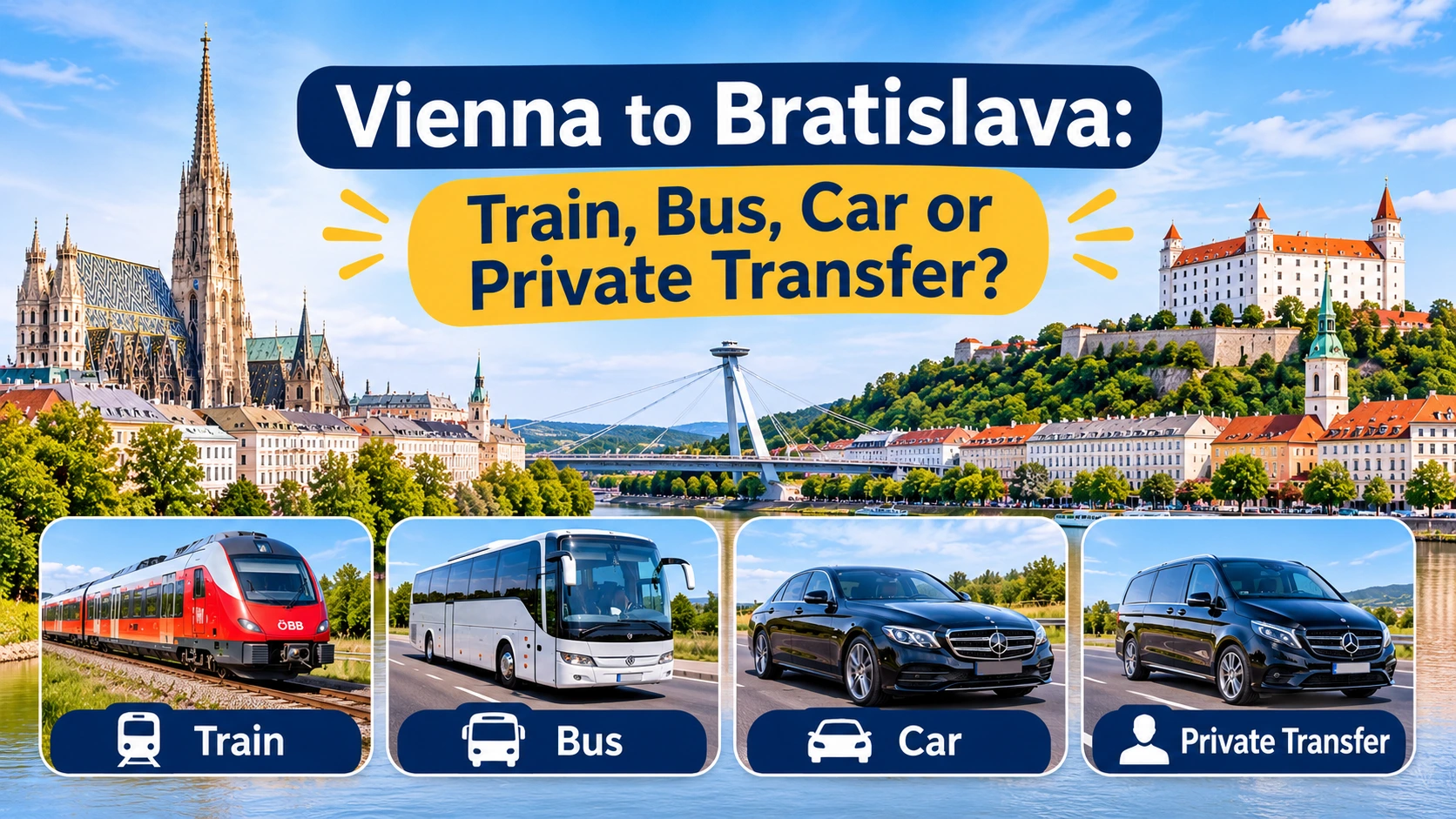
Travelling from Vienna to Bratislava is one of the easiest international journeys in Central Europe. The two capital cities are approximately 80 kilometres apart by road, and you can make the journey by train, bus, boat, car or private transfer.
For most independent travellers, the train is a convenient option because it connects Vienna Hauptbahnhof with Bratislava's main railway stations in around an hour. Buses offer another practical choice, while the Twin City Liner provides a scenic journey along the Danube. Driving or booking a private transfer can make more sense if you are travelling with luggage, children or a group.
However, the cheapest or fastest option is not necessarily the most convenient for every traveller. Your final destination in Bratislava matters too. Arriving at Bratislava hlavná stanica, Petržalka railway station, Nivy Bus Station or the city centre can make a noticeable difference to the rest of your journey.
This guide compares all five transport options, explains where each one arrives, and helps you choose the most practical way to travel from Vienna to Bratislava.
How Far Is Bratislava from Vienna?
Vienna and Bratislava are approximately 80 kilometres apart by road, depending on the starting and ending addresses. The railway distance and driving distance are different because they follow separate routes.
The journey is short enough for a day trip, business meeting or cross-border visit without requiring an overnight stay.
Here is a general comparison of the available transport options:
Transport | Approximate journey time | Best for |
Train | Around 1 hour | Speed and convenience |
Bus | Around 1–1.5 hours | Budget-conscious travellers |
Boat | Around 75–90 minutes | Scenic Danube travel |
Car | Around 1 hour | Flexible journeys |
Private transfer | Around 1 hour, depending on traffic | Door-to-door convenience |
These are general planning estimates, not guaranteed departure-to-arrival times. Traffic, service patterns, departure locations and seasonal schedules can change the actual journey.
Vienna to Bratislava by Train
For most travellers, the train is one of the simplest ways to reach Bratislava. ÖBB operates direct regional express connections from Vienna to the Slovak capital, with services connecting Vienna Hauptbahnhof to two different Bratislava railway stations.
Depending on the selected service, the journey takes approximately 56–60 minutes.
Check the official ÖBB timetable before travelling to compare departures, arrival stations, fares and return connections.
Which Bratislava train station should you choose?
This is an important detail that many general travel guides overlook. Not every train from Vienna arrives at the same station.
1. Bratislava hlavná stanica
Bratislava hlavná stanica is the city's main railway station. It is a practical arrival point for visitors planning to explore the historic centre, Bratislava Castle and nearby attractions.
You can continue towards the Old Town using local public transport or walk, depending on your destination and luggage.
2. Bratislava-Petržalka
Petržalka station is located south of the Danube. It can be convenient for certain journeys, but it is not the same location as the main railway station.
If your hotel or sightseeing destination is in the Old Town, you will need to arrange onward transport or allow time for the additional walk.
When booking, check the exact arrival station rather than selecting the first Bratislava result shown by a booking platform.
What is the Bratislava Ticket?
The ÖBB Bratislava Ticket is worth checking if you are planning a return journey.
It combines the cross-border train journey between Vienna and Bratislava with public transport benefits in Bratislava on the first day of validity. This can make it useful for visitors who intend to use local buses and trams after arriving.
The exact validity conditions and current price should be checked before purchasing.
See the official ÖBB Bratislava Ticket information for the current rules.
Is the train suitable for a day trip?
Yes. The relatively short journey makes Bratislava practical for a day trip from Vienna.
You can leave Vienna in the morning, explore the Old Town and major attractions, and return in the evening.
The main advantage is avoiding motorway traffic and the need to find parking in Bratislava. However, if you are travelling with several bags or need to reach an address outside the city centre, the train may require additional transport at both ends.
Vienna to Bratislava by Bus
Taking a bus is another practical option, especially if you want to compare lower fares or prefer a departure time that suits your schedule.
Operators including Slovak Lines and FlixBus serve the Vienna–Bratislava route. Depending on the service, journeys generally take around 1–1.5 hours.
Bus travel is affected by road traffic, so allow extra time during busy commuting periods, weekends and public holidays.
Where do buses leave from in Vienna?
Departure points depend on the operator and selected service.
Common locations include:
Wien Hauptbahnhof.
Vienna International Busterminal at Erdberg.
Other designated operator stops shown during booking.
Do not assume every Bratislava-bound coach departs from the same terminal. Check the exact boarding address on your ticket.
Where do buses arrive in Bratislava?
Services can use different arrival points, including:
Bratislava Nivy Bus Station.
Most SNP, near the Danube and the UFO Bridge.
Other designated stops depending on the operator.
Nivy is a major bus terminal with shopping, food and onward public transport connections. Most SNP is particularly useful for visitors heading towards the Old Town and riverside attractions.
If your hotel is near the historic centre, compare the actual arrival point rather than choosing a bus exclusively because its ticket is cheaper.
When should you choose the bus?
A bus may be the right option if:
You find a convenient departure and return time.
Your destination is close to the arrival stop.
You are travelling with a relatively small amount of luggage.
You want to compare budget fares with train tickets.
The main disadvantage is traffic uncertainty. A journey that normally takes around an hour can take longer when the roads are busy.
Check the Slovak Lines Vienna connections and FlixBus Vienna–Bratislava route for current schedules and booking conditions.
Vienna to Bratislava by Boat: Twin City Liner
If you want the journey itself to become part of your sightseeing experience, consider the Twin City Liner.
This high-speed catamaran connects Vienna with Bratislava along the Danube. Unlike the train or bus, it provides a river journey through the surrounding landscape.
The crossing generally takes approximately 75 minutes from Vienna to Bratislava. The return journey can take longer, depending on the direction and operating conditions.
Where does the Twin City Liner depart?
The regular Vienna departure point is the Twin City Liner landing stage near Schwedenplatz. However, temporary operational changes can affect the departure location.
Always check the operator's current travel information before heading to the pier.
In Bratislava, the boat arrives near the city centre, making it convenient for visitors who want to explore the riverside and Old Town.
Is the boat available throughout the year?
The Twin City Liner operates according to a seasonal timetable. Services, departure frequency and fares vary during the year.
Summer generally offers more sailing opportunities, while low-season and winter services may be more limited.
Weather, water levels and operational arrangements can also affect departures.
Check the official Twin City Liner timetable before booking.
Is the boat better than the train?
Not necessarily. The boat is primarily an experience rather than the most economical way to travel between the two capitals.
Choose it if you enjoy river journeys, want a different perspective of the Danube or are planning a special day trip.
For regular commuting, business travel or a budget-focused journey, the train is usually a more practical starting point.
Vienna to Bratislava by Car
Driving between Vienna and Bratislava gives you greater flexibility over your departure time and final destination.
The road journey is approximately 80 kilometres and generally takes around an hour in normal traffic. The actual route and duration depend on your starting address, destination and traffic conditions.
A commonly used route follows the A4 motorway towards the Austrian-Slovak border and continues towards Bratislava.
Before leaving, consider the following:
Check live traffic and road conditions.
Confirm parking availability at your destination.
Check motorway vignette and toll requirements in both countries.
Allow additional time during peak commuting periods.
Carry valid travel identification and documents.
Check whether your rental-car agreement permits cross-border travel.
Do you need a motorway vignette?
Austria and Slovakia have separate motorway toll arrangements.
If you use Austrian motorways, check the current requirements through ASFINAG.
For Slovakia, check the applicable rules through the official Slovak electronic motorway vignette system.
Requirements depend on the vehicle and the roads you use. Do not assume that an Austrian vignette covers driving on Slovak motorways.
Where can you park in Bratislava?
Parking depends on the area you want to visit.
The historic centre has restricted access in some streets and limited parking options. Rather than driving directly into the busiest pedestrian areas, look for a suitable public garage or designated parking facility near your accommodation or intended attraction.
If you are visiting for only a few hours, compare parking charges with the cost of arriving by train or bus.
When is driving the better choice?
Driving can make sense if you want to:
Visit Bratislava and continue to another destination in Slovakia.
Travel with several passengers.
Carry luggage or equipment.
Reach an address outside the central public transport network.
Combine several stops during one journey.
For a simple Old Town sightseeing trip, a car may create more work than it saves because you still need to arrange parking and navigate the city.
Vienna to Bratislava by Private Transfer
A private transfer is another option if you prefer to travel directly between specific addresses rather than arrange separate journeys to and from transport terminals.
Unlike scheduled trains and buses, a private transfer can be arranged around your departure time, pickup location and destination.
This can be useful for:
Families travelling with children.
Small groups sharing one vehicle.
Business travellers with fixed appointments.
Visitors carrying several suitcases.
Travellers staying outside central Vienna or Bratislava.
People who prefer not to manage station changes and local transport.
What should you check before booking?
Before confirming a Vienna-to-Bratislava private transfer, clarify:
The exact pickup and drop-off addresses.
The total price for the vehicle, not just a per-person estimate.
Passenger and luggage capacity.
Whether child seats are available when required.
Whether waiting time is included.
Whether the price covers the complete cross-border journey.
Cancellation and amendment conditions.
A private transfer generally costs more than public transport for an individual passenger. However, the comparison can change when several people share a vehicle or need direct transport to an address away from the main stations.
It is best considered a convenience option rather than automatically the cheapest or fastest choice.
Which Is the Best Way to Travel from Vienna to Bratislava?
The right transport depends on what matters most during your journey.
Your situation | Recommended option | Why |
Visiting the Old Town independently | Train | Direct cross-border connection |
Looking for a lower-cost ticket | Compare bus and train | Prices depend on departure and availability |
Enjoying the Danube scenery | Twin City Liner | The crossing becomes part of the experience |
Travelling with several bags | Private transfer | Direct pickup and drop-off |
Travelling with family or a group | Compare private transfer and train | Depends on group size and luggage |
Continuing beyond Bratislava | Car or private transfer | Greater flexibility for multiple stops |
Attending a business meeting | Private transfer or train | Depends on meeting location and timing |
For most independent day visitors, the train is a strong choice. The boat is attractive when the river journey is part of the plan, while a private transfer becomes more useful when direct access and group logistics matter.
A Practical One-Day Trip from Vienna to Bratislava
Bratislava is compact enough to explore in a day, provided you plan your arrival and return journey sensibly.
Here is a practical itinerary for visitors travelling independently.
Morning: Leave Vienna
Choose a morning train or bus that gives you enough time in Bratislava.
If you take the train, check whether your service arrives at Bratislava hlavná stanica or Petržalka. If you travel by bus, confirm whether you arrive at Nivy or Most SNP.
This small detail can save time when planning your first sightseeing stop.
Late Morning: Explore Bratislava Old Town
Start with the historic centre.
The Old Town is known for its pedestrian streets, traditional architecture, cafés and historic landmarks. You can explore the main streets on foot without arranging extensive local transport.
Consider visiting:
Michael's Gate.
Main Square.
Old Town Hall.
St Martin's Cathedral.
The surrounding historic streets and squares.
Allow time for photographs, coffee and a relaxed walk rather than trying to visit every attraction.
Afternoon: Visit Bratislava Castle
Bratislava Castle sits above the city and offers views across the Danube and surrounding area.
You can walk towards the castle from the Old Town, although the route includes an uphill section.
If you prefer not to walk uphill, consider local public transport or a taxi.
After visiting the castle, you can return towards the centre for lunch or continue exploring the riverfront.
Late Afternoon: Enjoy the Danube Riverside
The Danube waterfront offers a different perspective of Bratislava.
Walk near the river, visit the area around Most SNP and enjoy the views towards the castle and city skyline.
If you have chosen the Twin City Liner, make sure your sightseeing schedule leaves enough time to reach the departure pier.
Evening: Return to Vienna
Check the return train or bus timetable before leaving Vienna in the morning.
Do not rely on remembering the last departure time. If you have a fixed return requirement, choose a suitable service in advance and leave enough time to reach the station.
A day trip should feel relaxed, not like a race between attractions and departure boards.
Important Travel Tips Before Crossing from Vienna to Bratislava
Although the journey is short, you are travelling between two different countries. A few practical details can make the trip easier.
Carry valid travel documents
Austria and Slovakia are both in the Schengen Area, but travellers must still meet the applicable identification and entry requirements.
Carry a valid passport or accepted national identity document, as appropriate for your nationality and immigration status. Non-EU visitors should check their visa and residence-document conditions before travelling.
Check the correct station or terminal
Vienna and Bratislava both have multiple transport departure and arrival points.
Always use the exact station or stop printed on your booking confirmation. Do not assume that Bratislava's main railway station, Petržalka, Nivy and Most SNP are interchangeable locations.
Consider local public transport
Bratislava has buses, trams and trolleybuses that can help you reach attractions beyond walking distance.
The IDS BK official transport website provides information about tickets, zones and public transport.
If you purchase an ÖBB Bratislava Ticket, check its included local transport validity before purchasing an additional ticket.
Check your return journey
Return services are particularly important if you are travelling by boat or bus.
A train may offer more flexibility, but service frequency and last departures depend on the timetable. Plan your return around the activity you want to complete, not the other way around.
Frequently Asked Questions
What is the fastest way to travel from Vienna to Bratislava?
The train is generally one of the fastest and most predictable options, taking around an hour on suitable services. The car can also take approximately an hour in normal traffic, but delays may affect the journey.
How far is Vienna from Bratislava?
The cities are approximately 80 kilometres apart by road, depending on the starting and ending addresses.
Is there a direct train from Vienna to Bratislava?
Yes. ÖBB operates direct regional express services from Vienna Hauptbahnhof to Bratislava, with connections to both Bratislava hlavná stanica and Petržalka. Check the current timetable for the correct arrival station.
Is the bus cheaper than the train from Vienna to Bratislava?
It can be. Bus fares vary by operator, booking date and departure time. Compare the complete fare and arrival location rather than assuming the cheapest ticket will also be the most convenient.
Can you travel from Vienna to Bratislava by boat?
Yes. The Twin City Liner operates seasonal Danube catamaran services between the two cities. The journey takes approximately 75 minutes in one direction, subject to the current timetable and operating conditions.
Is Bratislava worth visiting as a day trip from Vienna?
Yes. Its Old Town, Bratislava Castle, historic landmarks and Danube waterfront make it suitable for a day trip. A morning departure and evening return generally allow time to explore the main central attractions.
Do I need a passport to travel from Vienna to Bratislava?
Travel-document requirements depend on your nationality and immigration status. Carry a valid passport or accepted identity document and check any visa conditions that apply to your situation.
Is a private transfer from Vienna to Bratislava worth it?
It may be worthwhile for families, groups, business travellers or visitors carrying substantial luggage. It provides direct pickup and drop-off, but generally costs more than public transport.
Does the Bratislava Ticket include local transport?
The ÖBB Bratislava Ticket includes public transport benefits in Bratislava on its first day of validity, subject to its current conditions. Check the official ÖBB ticket information before purchasing.
Can I visit Bratislava and return to Vienna on the same day?
Yes. Train and bus services make a same-day return practical. Check the outward and return timetable before travelling, particularly if you plan to use a seasonal boat service.
Final Checklist Before Travelling
Before leaving Vienna, confirm:
Your chosen transport option and departure location.
The exact arrival station, bus terminal or boat landing point.
Current ticket prices and booking conditions.
Return departure times.
Local public transport requirements in Bratislava.
Valid travel identification and any applicable visa conditions.
Parking and toll arrangements if driving.
Seasonal boat operating times if travelling by Twin City Liner.
Vienna and Bratislava are close enough to make cross-border travel straightforward, but the best transport option depends on your actual destination and travel arrangements.
The train is a convenient choice for most independent visitors, buses can offer competitive fares, and the Twin City Liner turns the journey into a scenic experience. Driving and private transfers provide more flexibility when you need direct access, additional luggage space or a journey beyond the city centre.
Choose your arrival point first, then select the transport that gets you there most conveniently.