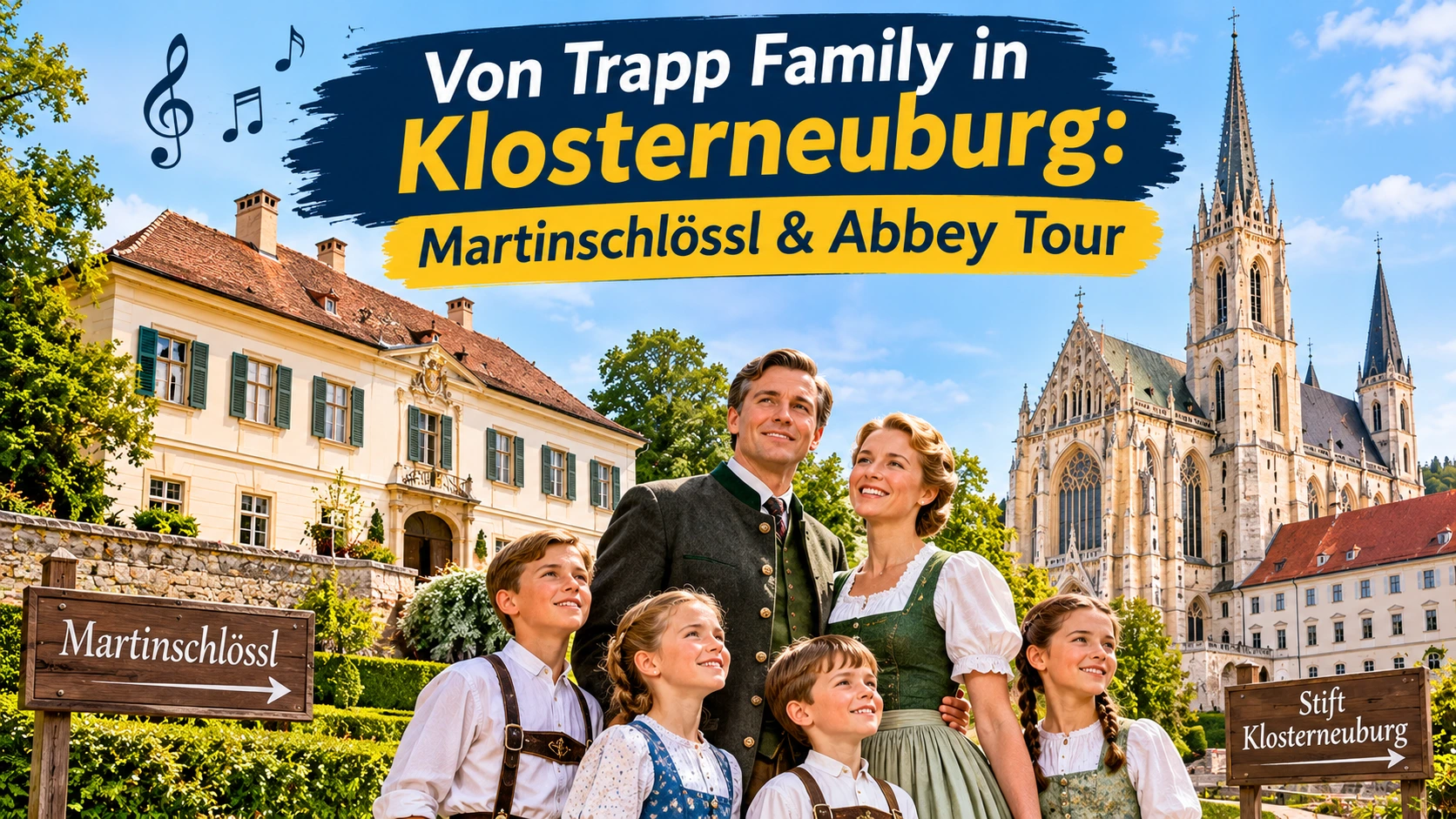
Before becoming internationally recognised through The Sound of Music, the real von Trapp family spent an important period of their lives in Klosterneuburg, a historic town northwest of Vienna.
Georg von Trapp, his first wife Agathe Whitehead and their six children arrived at Martinschlössl on 13 January 1921. Their seventh child, Martina, was born there on 17 February 1921. The property was offered to the family by Agathe's uncle, Bobby Whitehead.
Klosterneuburg also became an important part of the family's religious, educational and musical history. Their relationship with the Augustinian Canons of Klosterneuburg Abbey is now explored through a special private guided experience called A Quiet Beginning The von Trapp Family and Klosterneuburg Abbey.
There is an important distinction for visitors: Martinschlössl was the family's former home, whereas the Abbey is a separate historical institution. The special von Trapp tour takes place at the Abbey, not inside the family residence. No current public visiting arrangements for Martinschlössl have been confirmed.
For visitors interested in the real history behind the famous musical, Klosterneuburg reveals a lesser-known chapter that took place before the family's later association with Salzburg.
1. Who Were Georg and Agathe von Trapp?
Georg von Trapp was born on 4 April 1880 in Zara, now Zadar in Croatia. He pursued a naval career in the Austro-Hungarian Navy and became one of its recognised submarine commanders during the First World War.
His military career brought him considerable public attention, particularly following the sinking of the French cruiser Léon Gambetta in April 1915.
Georg married Agathe Whitehead, the granddaughter of Robert Whitehead, the engineer associated with the invention of the modern self-propelled torpedo.
The couple had seven children:
Rupert
Agathe
Maria
Werner
Hedwig
Johanna
Martina
Their family life was shaped by the political and economic changes following the First World War.
The collapse of the Austro-Hungarian Empire brought an end to the naval world in which Georg had built his career. Austria lost its coastline and no longer had the navy in which he had served.
The family consequently faced a different future from the one they had originally expected.
Their move to Klosterneuburg was part of this transition. It provided a new home for Georg, Agathe and their children during a period of significant change.
For additional historical context, read the Wien Museum's account of the real von Trapp family.
2. Why Did the von Trapp Family Move to Klosterneuburg?
Before arriving in Klosterneuburg, the family had been living in the Zell am See area, including a period at the Hotel Kitzsteinhorn.
According to Agathe von Trapp's autobiography, a serious problem developed during the summer of 1920. Melting glaciers caused the lake to rise, and water entered the lower part of the family's accommodation.
The kitchen became flooded, and food supplies had to be moved upstairs. The situation made the property increasingly unsuitable for a household with several young children.
At that point, Agathe's youngest brother, Bobby Whitehead, offered them a property he owned in Klosterneuburg.
The property was called Martinschlössl, meaning Martin's little castle.
Agathe remembered it as a spacious residence with:
A caretaker's house.
A greenhouse.
An orchard.
A landscaped garden.
Space for growing vegetables and fruit.
Outbuildings suitable for keeping animals.
The arrangement was intended to provide a temporary home until Georg and Agathe could find a suitable permanent residence.
Before the move was completed, Agathe also travelled to Pola to arrange the recovery and transportation of the family's furniture and belongings.
The family spent Christmas 1920 with relatives at Goldegg Castle while preparations continued.
On 13 January 1921, all six children travelled to Klosterneuburg and were reunited with their parents at Martinschlössl.
This date establishes a clear starting point for the family's life in the town.
The family details are drawn from Agathe's first-person account, Memories Before and After the Sound of Music.
3. Life at Martinschlössl: The Family's Home Near Vienna
Martinschlössl became more than a temporary address. For the children, it was a place where everyday family life gradually returned to a familiar routine.
Agathe's memoir provides one of the most detailed descriptions of the property and its household arrangements.
The estate had enough space for the family, domestic staff and agricultural activities. Its gardens and orchards offered room to play and explore, while the outbuildings supported the family's daily needs.
What Was the House Like?
Agathe remembered arriving at the property and being reunited with her parents after a journey from Goldegg.
The house had an elegant appearance, with furniture that the family had brought from their previous home in Pola.
She recalled a green front door with brass handles and a door knocker.
Inside, different floors served different purposes. The upper floor accommodated some of the older children, together with rooms for household staff. The main living areas included the dining room, living room, parents' bedroom and a bathroom.
The nursery and children's playroom were also important parts of the house.
For the children, the house represented stability after several years of disrupted family life.
What Was Everyday Family Life Like?
Agathe's memoir describes a structured daily routine.
The older children received lessons from their governess, Fräulein Freckmann. Their days included morning lessons, lunch, playtime, an afternoon walk and homework.
One particularly memorable part of the routine was the afternoon Jause, an Austrian tradition similar to afternoon tea.
The children enjoyed milk, bread, butter and jam before returning to their studies.
Dinner was generally served at 7:30 pm.
Music also formed part of everyday life. The children sang together and listened to gramophone records, including classical music.
The Household and Animals
Agathe's account identifies three cows, chickens and one or two pigs. There was also a vegetable garden, which helped the family maintain some independence during a period of food shortages.
The Stiegler family, Franz and Marie with their three children, helped look after the property and its animals.
The main household included the cook, three maids, a governess and a nanny, alongside Georg, Agathe and their seven children.
These memories provide a more personal picture of the family than the simplified household sometimes portrayed in popular entertainment.
Martinschlössl was a working family estate, not simply a grand residence. Its gardens, domestic routines, staff and shared activities shaped the children's experience of life in Klosterneuburg.
4. Martina von Trapp's Birth: Why Was She Named After Martinschlössl?
One of the strongest historical connections between the family and Klosterneuburg is the birth of Martina von Trapp.
She was born on 17 February 1921, just over a month after the family arrived at Martinschlössl.
Her birth brought the number of Georg and Agathe's children to seven.
Agathe's memoir describes how the older children were introduced to their new baby sister.
The parents had not decided on a name immediately. The children discussed different possibilities before someone suggested Martina.
The name had a particular meaning because of the family's new surroundings.
It was connected to three local references:
Martinschlössl, the family's residence.
Martinstraße, the street where the house stood.
Martinskirche, the nearby Church of St Martin.
The children agreed that Martina was the right name.
This small family memory establishes an unusually direct connection between the von Trapp family and the town.
Martina was not simply born in Klosterneuburg. Her name reflected the place where the family had begun a new chapter of their lives.
5. The Children's Education and Their Local Klosterneuburg Connections
The family's connection to Klosterneuburg was not limited to their residence. Education also formed an important part of the children's everyday lives.
Agathe's memoir describes how the older children received individual lessons at home from Fräulein Freckmann during their early period at Martinschlössl.
Their studies followed the school curriculum, with additional activities such as arts, crafts and singing.
Local reporting published by MeinBezirk on 12 October 2026 states that three of the von Trapp children attended Gymnasium Klosterneuburg.
The report does not identify all three children by name, so it would be inaccurate to assign specific names without additional school records.
What is clear is that Klosterneuburg formed part of the children's educational environment.
Read the MeinBezirk report on The Sound of Music in Klosterneuburg.
6. How Was the Family Connected to Klosterneuburg Abbey?
Klosterneuburg Abbey is one of the most important historical institutions in the town.
It was founded by Margrave Leopold III in 1114 and has been associated with the Augustinian Canons for centuries.
The von Trapp family's relationship with the Abbey forms a distinct part of the history explored by the institution today.
The Abbey's special historical tour describes connections involving faith, education, sacred music and personal relationships with members of the Augustinian community.
Faith and Religious Life
Religious life was an important element of the family's Austrian background.
Agathe's memoir describes the children's religious education, their Sunday Mass attendance and the influence of their governess, Fräulein Freckmann.
The Abbey's interpretation of the family's history focuses on daily encounters with worship and the spiritual environment surrounding the children.
Education and the Abbey's Surroundings
The Abbey also highlights education within its historic surroundings as part of the family's connection.
It is important to distinguish this from the family's home at Martinschlössl.
The Abbey was not their family residence. Martinschlössl and Klosterneuburg Abbey are separate places with different historical roles.
Sacred Music and Family Music-Making
Music was already an important part of the von Trapp family's life before their later international performances.
Agathe's memoir describes singing, musical instruction and listening to classical music during childhood.
The Abbey's tour connects this background with sacred music and the family's musical relationships within the monastic community.
Personal Relationships with the Augustinian Canons
The Abbey also highlights friendships and personal connections with the Augustinian Canons.
These relationships are part of the institution's interpretation of the family's early Klosterneuburg period.
For visitors interested in this particular chapter of the von Trapp story, the Abbey offers a way to explore the historical connection through its own archival material and guided interpretation.
See the official A Quiet Beginning tour information.
7. Agathe von Trapp's Illness, Death and Its Impact on the Family
One of the most difficult chapters in the family's Klosterneuburg history occurred during the scarlet fever outbreak of 1921–1922.
Agathe's memoir describes how the illness spread through the town and affected several members of the household.
The children became sick, and the nursery was turned into a place where they could be cared for.
Martina, still a very young baby, was particularly unwell.
Agathe took responsibility for caring for the children, but she also contracted scarlet fever.
Her illness became severe.
According to her daughter's account, she was taken to Sanatorium Loew in Vienna, where she received treatment over an extended period.
After several months, she returned to Martinschlössl in August 1922.
She was extremely weak and required a wheelchair.
The family hoped that she would recover. However, on the morning of 3 September 1922, Agathe Whitehead von Trapp died.
The children were not immediately told what had happened. Georg wanted them to remember their mother as they had known her before the illness.
The death of their mother changed the family's circumstances permanently.
Georg was left responsible for seven children, while the household had to adjust to the absence of the person who had managed much of its daily life.
It was a place of new beginnings, but also the location of a profound family loss.
8. When Did the von Trapp Family Leave Klosterneuburg for Salzburg?
The family's later move to Salzburg is an important transition in the wider von Trapp story.
However, published sources do not all give the same departure year.
Wien Museum states that Georg moved with the children to a villa in Aigen, Salzburg, in 1923, approximately one year after Agathe's death.
Agathe's memoir includes a photograph caption identifying Martinschlössl as the family's home near Vienna from 1921 to 1925.
A July 2024 report by Kurier also states that the family moved to Salzburg from 1925.
These sources establish the broad sequence but do not provide one universally agreed departure date.
| Event | Date or source |
|---|---|
| Six children arrived at Martinschlössl | 13 January 1921 |
| Martina's birth | 17 February 1921 |
| Agathe's death | 3 September 1922 |
| Move to Aigen, according to Wien Museum | 1923 |
| Martinschlössl home period in Agathe's photo caption | 1921–1925 |
| Relocation described by Kurier | From 1925 |
The most responsible approach is to describe the move as taking place during the early-to-mid-1920s rather than presenting one disputed year as certain.
For comparison, see the Wien Museum's historical account and Kurier's report on Martinschlössl.
It was in Salzburg that Maria Augusta Kutschera later joined the household as a teacher to one of Georg's daughters.
Her relationship with the family eventually became central to the story adapted into The Sound of Music.
9. A Quiet Beginning: Inside the Special von Trapp Abbey Tour
Visitors interested in the family's Klosterneuburg history now have an opportunity to explore the Abbey's interpretation of this period through a dedicated experience.
The tour is called:
A Quiet Beginning — The von Trapp Family and Klosterneuburg Abbey.
According to the official Abbey website, it is an approximately 90-minute private and exclusive guided experience.
Rather than concentrating on the family's later fame, the experience focuses on their early years in Klosterneuburg and the Abbey's interpretation of their relationship with the monastic community.
What Does the Tour Include?
The experience takes visitors through selected parts of the Abbey, including:
The Abbey Church
The church provides the setting for exploring the religious environment associated with the family's early years.
The Cloister
The historic cloister forms another part of the experience, connecting the visitor with the monastic surroundings of Klosterneuburg Abbey.
The Leopold Chapel and Verdun Altar
The Leopold Chapel contains the famous Verdun Altar, one of the Abbey's most significant historical and artistic treasures.
Archival Letters and Historical Documents
A particularly important part of the experience is the use of selected archival material, family letters and historical documents.
Is the Special Tour Included in Standard Admission?
No.
The Abbey explicitly identifies A Quiet Beginning as a private guided experience that is not included in the standard admission ticket.
Buying an ordinary Abbey admission ticket does not automatically provide access to this dedicated von Trapp experience.
Can Individuals Join a Public Tour?
The official page describes A Quiet Beginning as a private and exclusive experience.
It does not publish a regular public departure schedule or confirm whether individual visitors can join an existing group.
If you are travelling alone or as a couple, consult the Abbey's official tour information to ask about possible booking arrangements.
How Can You Arrange the Special Tour?
For exclusive group booking enquiries, consult the Abbey's official tour information and its official contact page.
Before making travel arrangements, confirm:
Whether your requested date is available.
The price of the private experience.
The minimum and maximum group size.
The language in which the experience can be conducted.
Any advance booking requirements.
Whether standard admission is also required.
The official tour page does not currently publish all these details, so they should be confirmed directly with the Abbey.
10. Can You Visit Martinschlössl Today?
For visitors interested in seeing the actual place where the family lived, Martinschlössl is a separate destination from Klosterneuburg Abbey.
The Austrian Federal Monuments Office lists the protected property as:
Martinstraße 32–36, 3400 Klosterneuburg, Austria.
This is the official heritage-listing address range rather than a confirmed visitor entrance. Consult the Federal Monuments Office's protected-building register.
A July 2024 report by Kurier identified the property as belonging to the Porsche family at that time. The building was not presented as a regular public museum or visitor attraction with scheduled tours.
On 11 July 2024, a fire broke out in the roof structure of the protected building. Local reporting described damage to parts of the property.
These reports establish what happened in 2024, but they do not establish the building's present condition or whether visitor access has subsequently been arranged.
For the incident, see ORF Lower Austria's fire report.
I could not identify a current official opening schedule, public tour or visitor-access arrangement for Martinschlössl.
Therefore, do not assume that you can enter the building, explore its rooms or access its gardens.
If seeing the former family home is important to your visit, confirm the current situation and obtain permission before making a special journey.
Martinschlössl vs Klosterneuburg Abbey: What Is the Difference?
| Martinschlössl | Klosterneuburg Abbey |
|---|---|
| Former von Trapp family residence | Historic Augustinian monastery |
| Listed at Martinstraße 32–36 | Located at Stiftsplatz 1 |
| Reported as privately owned in 2024 | Public visitor attraction |
| No current public tour confirmed | Regular visitor admission and guided tours |
| Associated with family life and Martina's birth | Associated with the family's religious, educational and musical history |
These are two separate locations.
The special A Quiet Beginning experience takes place at the Abbey. It does not provide access to Martinschlössl.
Understanding this distinction will help you plan a more accurate visit.
11. The Real von Trapp Family vs The Sound of Music
The popularity of The Sound of Music has made the von Trapp family one of the most recognisable Austrian family stories internationally.
However, the film and musical adapted the historical events rather than reproducing them exactly.
The real family included ten children in total: seven from Georg's first marriage to Agathe Whitehead and three from his later marriage to Maria Augusta Kutschera.
The film concentrates on the seven children from Georg's first marriage.
There are also differences in the portrayal of Georg.
Agathe von Trapp's memoir describes a father who was caring, involved in his children's education and interested in music.
She specifically challenged the film's portrayal of him as a cold, distant naval officer.
The timing of the marriage is another important difference.
Georg and Maria married on 26 November 1927, years before the family's departure from Austria in 1938. The film rearranges this chronology to create a more dramatic sequence.
The family's escape is also portrayed differently. In the film, the family crosses the mountains into Switzerland. In reality, the family travelled by train through Italy before eventually reaching the United States.
For a documented comparison, read the US National Archives article on the real von Trapp family.
For readers interested in the film's later Austrian locations, explore this two-day Salzkammergut itinerary from Vienna, which includes Mondsee and its connection with the film's famous wedding scene.
12. How to Fit Klosterneuburg into a Vienna Itinerary
Klosterneuburg is close enough to Vienna to work as a half-day excursion, particularly if the main purpose is to visit the Abbey.
However, the time required depends on what you want to experience. A standard Abbey visit is different from the dedicated von Trapp experience, which lasts approximately 90 minutes and requires a separate private booking.
Is a Half-Day Visit Enough?
A half-day can be suitable if you are concentrating on Klosterneuburg Abbey and its historical attractions.
If you have arranged the A Quiet Beginning experience, allow time for the guided tour and confirm the appointment before planning the rest of your day.
If you want to explore additional attractions around the town or combine Klosterneuburg with other destinations outside Vienna, a longer itinerary may be more appropriate.
Can You Visit Martinschlössl and the Abbey Together?
Both locations are connected to the same historical story, but they are separate properties.
The Abbey is an established visitor attraction with guided experiences. Martinschlössl, on the other hand, has no confirmed public visiting programme.
For that reason, the Abbey should be the main planned attraction. Martinschlössl should be treated as historical context rather than a guaranteed interior visit or bookable stop.
When Does a Custom Multi-Stop Journey Make Sense?
If Klosterneuburg Abbey is your only destination outside Vienna, the direct public transport connections are a practical option.
However, visitors who want to combine the Abbey with other independently selected destinations may prefer to plan a multi-stop journey rather than organise each leg separately.
A custom multi-stop private itinerary can be considered when the route needs to include Klosterneuburg alongside other places of interest.
The important point is to decide which locations you genuinely want to visit and how much time each requires before finalising the route.
A private journey does not provide automatic entry to the Abbey's special tour or Martinschlössl. Those arrangements must still be confirmed with the respective property.
Frequently Asked Questions
Did the von Trapp family live in Klosterneuburg?
Yes. Georg von Trapp, his first wife Agathe Whitehead and their children lived at Martinschlössl in Klosterneuburg from January 1921. It was an important family residence before their later move to Salzburg.
Where was Martinschlössl located?
Martinschlössl is listed by Austria's Federal Monuments Office at Martinstraße 32–36 in Klosterneuburg, Lower Austria. It was the property offered to the family by Agathe's uncle, Bobby Whitehead.
Was Martina von Trapp born in Klosterneuburg?
Yes. Martina von Trapp was born on 17 February 1921 at Martinschlössl. According to Agathe's memoir, her name was chosen because of the property's connection with Martinstraße and the nearby Martinskirche.
Can visitors enter Martinschlössl?
No current public visitor programme or interior tour has been confirmed in the sources reviewed. The property was reported as privately owned in 2024, so visitors should not assume that entry is permitted.
Did the von Trapp family live inside Klosterneuburg Abbey?
No. Their family residence was Martinschlössl, a separate property in Klosterneuburg. Their relationship with the Abbey involved religious, educational and musical connections explored through the institution's special guided experience.
What is the A Quiet Beginning tour?
It is a private guided experience at Klosterneuburg Abbey dedicated to the von Trapp family's early years in the town. It lasts approximately 90 minutes and includes selected Abbey locations and archival historical material.
Is the von Trapp tour included in standard Abbey admission?
No. The official Abbey website states that A Quiet Beginning is a private guided experience and is not included in standard admission.
Can individuals join a public von Trapp tour?
The Abbey does not publish a regular public departure schedule for this experience. It describes the tour as private and exclusive. Individual visitors should consult the Abbey's official tour information to ask about possible booking arrangements.
When did the family move from Klosterneuburg to Salzburg?
The precise departure year differs between sources. Wien Museum places the move to Aigen in 1923, while Agathe's memoir identifies Martinschlössl as the family home from 1921 to 1925. Kurier also reports a move from 1925. The safest conclusion is that the relocation took place during the early-to-mid-1920s.
Was The Sound of Music filmed at Martinschlössl?
The available historical sources identify Martinschlössl as the real family's former home, not as a confirmed filming location for the Hollywood movie. Treat it as a historical family residence rather than a film attraction.
Plan Your Visit
Klosterneuburg Abbey is located northwest of Vienna and can be reached by public transport or car.
By S40: Travel from Wien Heiligenstadt towards Klosterneuburg-Kierling. From the station, allow approximately 15 minutes to walk to the Abbey.
By Bus 400 or 401: Travel from Wien Heiligenstadt to Klosterneuburg–Stiftsgarten. From there, allow approximately 10 minutes to walk through the gardens to the visitor entrance.
By Car: The Abbey is approximately a 10-minute drive from Vienna's city limits via the B14. On-site parking is available, with up to four hours of free parking when the ticket is validated at visitor reception.
Address:
Stift Klosterneuburg
Stiftsplatz 1
3400 Klosterneuburg, Austria
Opening Hours
| Season | Opening hours |
|---|---|
| Summer: 1 May–15 November | 9:00 am–6:00 pm |
| Winter: 16 November–30 April | 10:00 am–4:00 pm |
The Abbey is closed on 24–26 December and 31 December–2 January.
Always check the official visitor information before travelling, particularly if you are interested in the private von Trapp experience.
Before setting out, decide whether your priority is the Abbey's historical experience or a wider exploration of Klosterneuburg and the surrounding area. Confirm the special tour in advance and do not assume Martinschlössl is open to visitors.
A Final Thought
The von Trapp family's time in Klosterneuburg offers a different perspective on a story many people know primarily through The Sound of Music. Martinschlössl represents their family life, Martina's birth and a difficult period following Agathe's illness, while the Abbey preserves a separate part of their local historical connection.
Understanding both locations makes it easier to appreciate why Klosterneuburg deserves a place in the wider history of the von Trapp family, beyond the familiar landmarks of Salzburg.