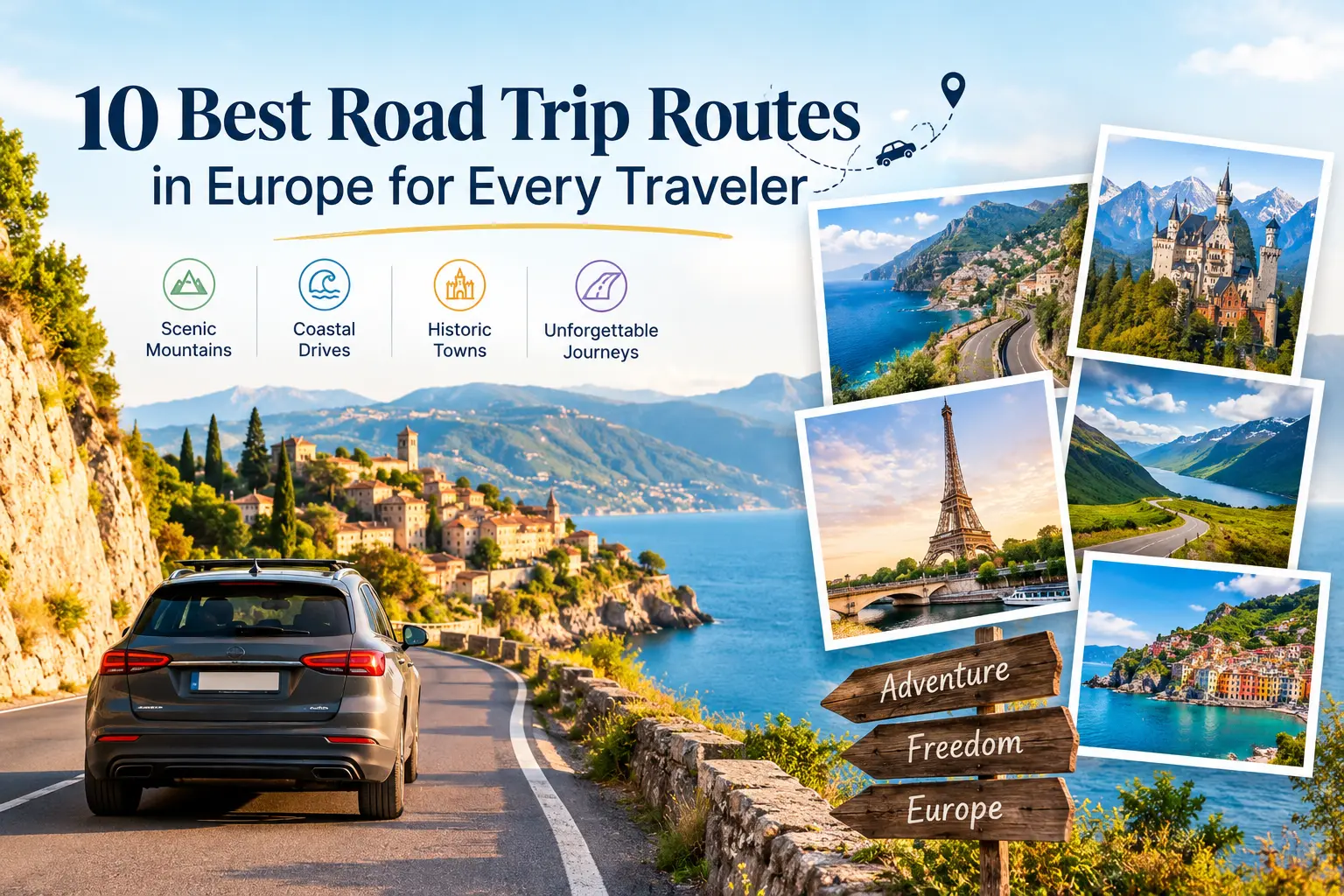
Quick Summary: The best road trip routes in Europe include Germany's Romantic Road for medieval towns and castles, Austria's Grossglockner High Alpine Road for glacier views, Italy's Dolomites for dramatic limestone passes, Slovenia's Julian Alps for emerald rivers, and Croatia's Dalmatian Coast for sunny Adriatic towns. Travelers seeking romantic coastal or vineyard drives often choose Italy's Amalfi Coast or Portugal's Douro Valley, while Ireland's Wild Atlantic Way, Scotland's North Coast 500, and Iceland's Ring Road deliver unforgettable multi-day wilderness adventures.
Few travel experiences match the freedom of a European road trip. Because Europe packs such diverse cultures and landscapes into a compact map, just a few hours behind the wheel can take you from snow-dusted Alpine peaks and quiet vineyard valleys to ancient Roman ports and dramatic Atlantic cliffs.
Whether you have a long weekend for a mountain pass in Central Europe or two full weeks to circle an island coastline, the secret to a memorable journey is picking a route that fits your pace. Here are 10 of the best road trip routes in Europe, complete with start and end points, realistic driving times, standout stops, and practical advice for the road.
Best Road Trip Routes in Europe at a Glance
| Road Trip Route | Start & End Points | Distance | Pure Driving Time | Ideal Duration | Best Season | Best For |
| 1. Romantic Road, Germany | Würzburg to Füssen | 460 km | 6.5 to 7.5 hours | 3 to 5 days | May to October | History, castles, and medieval villages |
| 2. Grossglockner High Alpine Road, Austria | Bruck (Fusch) to Heiligenblut | 48 km | 1.5 to 2 hours | 1 to 2 days | May to early Nov | High Alpine peaks and glaciers |
| 3. The Dolomites, Italy | Bolzano to Cortina d'Ampezzo loop | 300 km | 6 to 7 hours | 3 to 5 days | June to September | Mountain passes and photography |
| 4. Julian Alps & Soča Valley, Slovenia | Lake Bled to Kobarid & Bohinj | 280 km | 5.5 to 6.5 hours | 3 to 5 days | May to October | Turquoise rivers and outdoor adventure |
| 5. Dalmatian Coast, Croatia | Zadar to Dubrovnik | 390 km | 6 to 7 hours | 5 to 7 days | May, June, Sept | Adriatic beaches and historic coastal cities |
| 6. Amalfi Coast, Italy | Sorrento to Ravello (SS163) | 60 km | 2 to 2.5 hours | 2 to 3 days | April to June, Sept | Cliffside views and romantic escapes |
| 7. Douro Valley, Portugal | Porto to Pinhão (via N222) | 260 km | 4.5 to 5 hours | 2 to 4 days | April to June, Sept to Oct | Terraced vineyards and relaxed dining |
| 8. Wild Atlantic Way, Ireland | Kinsale to Malin Head | 2,500 km | 45 to 50 hours | 10 to 14 days | May to September | Rugged ocean cliffs and coastal towns |
| 9. North Coast 500, Scotland | Inverness circular loop | 830 km | 16 to 18 hours | 5 to 7 days | May to September | Remote Highlands and wild beaches |
| 10. Ring Road (Route 1), Iceland | Reykjavík circular loop | 1,322 km | 17 to 20 hours | 7 to 10 days | June to September | Waterfalls, glaciers, and volcanic landscapes |
1. The Romantic Road, Germany: Best for History and Culture
Start and End Points: Würzburg to Füssen
Approximate Distance: 460 km (285 miles)
Pure Driving Time: 6.5 to 7.5 hours
Recommended Duration: 3 to 5 days
Major Attractions: Würzburg Residence, Rothenburg ob der Tauber, Dinkelsbühl, Nördlingen, Augsburg, and Neuschwanstein Castle
Germany's Romantic Road (Romantische Straße) is a classic introduction to driving in Europe, especially for travelers drawn to medieval architecture, cobblestone squares, and fairytale castles. Stretching south from the Franconian wine country around Würzburg to the Bavarian Alps in Füssen, this scenic route links more than two dozen historic towns.
Start at the Baroque Würzburg Residence before winding south to Rothenburg ob der Tauber, where intact 14th-century town walls and timber-framed houses look untouched by modern life. Continue through the medieval streets of Dinkelsbühl, the walled meteor-crater town of Nördlingen, and historic Augsburg before reaching Füssen, the gateway to Neuschwanstein Castle.
Best Time to Visit: May to October brings warm weather for walking tours and outdoor cafés, while December transforms the town squares with traditional Christmas markets.
Planning Tip: Follow the brown Romantische Straße signs along the country roads rather than rushing down the A7 autobahn. Many travelers extend this trip eastward into Austria via Munich and Salzburg. Our Vienna to Salzburg drive time guide covers what to expect if you link Bavaria with Austria.
2. Grossglockner High Alpine Road, Austria: Best for Mountain Scenery
Start and End Points: Bruck (Fusch) to Heiligenblut
Approximate Distance: 48 km (30 miles)
Pure Driving Time: 1.5 to 2 hours nonstop (allow 4 to 6 hours with viewpoint stops)
Recommended Duration: 1 to 2 days
Major Attractions: Edelweißspitze viewpoint, Hochtor Tunnel (2,504 m), Kaiser-Franz-Josefs-Höhe, Pasterze Glacier, and Heiligenblut village
If you want a world-class Alpine driving experience without committing to a week-long itinerary, Austria's Grossglockner High Alpine Road (Großglockner Hochalpenstraße) is unforgettable. Winding through Hohe Tauern National Park via 36 numbered hairpin turns, this smooth mountain road climbs to 2,504 meters at the Hochtor tunnel, taking you from green valley pastures right up to high-altitude ice.
The highlight is the Kaiser-Franz-Josefs-Höhe visitor terrace, where you look directly across at Austria's highest mountain, the Grossglockner (3,798 meters), and the Pasterze Glacier below, often with wild Alpine marmots and ibex in view.
Best Time to Visit: Open seasonally from early May to early November depending on snow conditions.
Planning Tip: Because this is a protected panoramic mountain road, it requires a separate day pass (€46.50 per car or €40.00 for electric vehicles in 2026) in addition to Austria's standard motorway vignette. Start before 9:00 AM for the clearest summit skies, and bring a warm jacket even in July. Travelers pairing the high Alps with Austria's lake district can also check our 2 day Salzkammergut itinerary from Vienna.
3. The Dolomites, Italy: Best for Photography and Outdoor Adventures
Start and End Points: Bolzano, Val Gardena, Cortina d'Ampezzo, and Lago di Braies loop
Approximate Distance: 300 km (186 miles) for the central mountain pass circuit
Pure Driving Time: 6 to 7 hours
Recommended Duration: 3 to 5 days
Major Attractions: Alpe di Siusi, Seceda, Passo Gardena, Passo Pordoi, Tre Cime di Lavaredo, Cortina d'Ampezzo, and Lago di Braies
Few mountain ranges on earth photograph like the Italian Dolomites. Famous for their pale, jagged limestone peaks that glow rose-pink at sunrise and sunset (Enrosadira), this UNESCO World Heritage region in Northern Italy blends high-altitude mountain passes with a distinctive mix of Italian and South Tyrolean culture.
A flexible circuit starts in Bolzano, climbs into Val Gardena (Ortisei), crosses the sweeping switchbacks of Passo Gardena and Passo Pordoi, and continues through Cortina d'Ampezzo to the Tre Cime di Lavaredo trailhead and the emerald waters of Lago di Braies.
Best Time to Visit: June to September for open mountain passes and summer hiking, or late September to mid-October for golden autumn larch trees and quieter roads.
Planning Tip: Short distances on the map take much longer here because of tight mountain curves and viewpoint stops. In July and August, popular spots like Lago di Braies require advance parking reservations or local shuttle buses during midday hours. If you are approaching Northern Italy from Austria and prefer to skip the long highway stretch before starting your mountain drive, you can arrange a comfortable Vienna to Innsbruck transfer and pick up your rental car right in the Alps.
4. Julian Alps and Soča Valley, Slovenia: Best for Nature and Adventure
Start and End Points: Lake Bled to Kranjska Gora, Vršič Pass, Bovec, Kobarid, and Lake Bohinj
Approximate Distance: 280 km (174 miles) loop
Pure Driving Time: 5.5 to 6.5 hours
Recommended Duration: 3 to 5 days
Major Attractions: Lake Bled and Bled Island, Vintgar Gorge, Vršič Mountain Pass, Soča River gorge, Kozjak Waterfall, and Lake Bohinj
Slovenia is a dream for road trippers who want dramatic nature without exhausting daily driving hours. Its compact northwest corner brings together fairytale lakes, towering limestone walls, and one of Europe's clearest turquoise rivers within a single manageable loop.
Start at Lake Bled, famous for its tiny island church and cliffside castle, before visiting quieter Lake Bohinj inside Triglav National Park. From Kranjska Gora, drive over the 50 hairpin bends of the Vršič Pass (1,611 meters) into the Soča Valley, following the vivid emerald waters of the Soča River through Bovec and Kobarid for suspension bridge walks, waterfalls, kayaking, and renowned local dining.
Best Time to Visit: May to October, when the high Vršič Pass is clear of snow.
Planning Tip: Slovenia requires a digital motorway vignette (e-vinjeta) registered to your license plate (€16.00 for a 7-day car pass in 2026), which you can purchase online before crossing the border.
5. The Dalmatian Coast, Croatia: Best for Beaches and Coastal Towns
Start and End Points: Zadar to Šibenik, Split, Makarska Riviera, and Dubrovnik
Approximate Distance: 390 km (242 miles) along the D8 Adriatic Coastal Road
Pure Driving Time: 6 to 7 hours
Recommended Duration: 5 to 7 days
Major Attractions: Zadar Sea Organ, Krka National Park, Šibenik Cathedral, Diocletian's Palace in Split, Makarska Riviera beaches, Pelješac Bridge, and Dubrovnik Old Town
Following Croatia's scenic D8 Adriatic Coastal Road (Jadranska Magistrala) gives you dramatic mountain backdrops on one side and the deep blue Adriatic Sea on the other. This route is ideal for travelers who want to balance morning drives with afternoon swims, Roman history, and fresh Mediterranean seafood.
Begin in Zadar to hear the wave-powered Sea Organ at sunset, detour to the waterfalls of Krka National Park and historic Šibenik, and explore the ancient Roman walls of Diocletian's Palace in Split. Continuing south past the pebble beaches of the Makarska Riviera, you cross the modern Pelješac Bridge, which keeps you inside Croatia without crossing the Bosnian border corridor, before finishing at the walled Old Town of Dubrovnik.
Best Time to Visit: May, June, and September offer warm sea water for swimming without the peak heat and traffic of July and August.
Planning Tip: If you plan to take your car onto islands such as Brač or Hvar, reserve your Jadrolinija car ferry tickets online in advance during summer and arrive at the port early.
6. The Amalfi Coast, Italy: Best for Romantic Escapes
Start and End Points: Sorrento to Positano, Amalfi, and Ravello
Approximate Distance: 60 km (37 miles) along the SS163 coastal road
Pure Driving Time: 2 to 2.5 hours
Recommended Duration: 2 to 3 days
Major Attractions: Sorrento cliffs, Positano beach, Fiordo di Furore, Amalfi Cathedral, and the hilltop gardens of Villa Rufolo and Villa Cimbrone in Ravello
Carved into steep limestone cliffs high above the Tyrrhenian Sea, Italy's Amalfi Coast (Costiera Amalfitana) is one of the world's most recognizable coastal drives. Along the narrow SS163 highway, pastel houses cling to vertical slopes, terraced lemon groves perfume the air, and every bend opens onto another sweeping Mediterranean view.
The route connects Sorrento with cliffside Positano, the historic maritime town of Amalfi, and the peaceful hilltop villas of Ravello.
Best Time to Visit: April to early June and late September to October provide sunny terrace weather without the heavy traffic of midsummer.
Planning Tip: This is a route to savor slowly, though self-driving here comes with challenges. The coastal road is very narrow, parking garages cost €8 to €12 per hour, and peak-season rules restrict non-resident cars by odd and even license plate numbers on alternating days. Many travelers prefer to stay in one base town and hire a local chauffeur or use coastal ferries between villages.
7. The Douro Valley, Portugal: Best for Wine Landscapes and Relaxation
Start and End Points: Porto to Peso da Régua, Pinhão, and Vila Nova de Foz Côa
Approximate Distance: 260 km (161 miles) round trip
Pure Driving Time: 4.5 to 5 hours
Recommended Duration: 2 to 4 days
Major Attractions: Historic Porto, Peso da Régua, the N222 riverside road, Pinhão train station tiles, São Leonardo de Galafura viewpoint, and historic wine estates (quintas)
For a slower road trip built around food, wine, and peaceful river scenery, northern Portugal's Douro Valley is hard to beat. Leaving historic Porto, you head inland to Peso da Régua, where you pick up the famous Estrada Nacional 222 (N222), a scenic ribbon of road that hugs the curves of the Douro River all the way to Pinhão.
Centuries-old stone vineyard terraces rise steeply on both sides of the water. Spend your days stopping at high ridge viewpoints (miradouros) like São Leonardo de Galafura, cruising the river on a traditional wooden rabelo boat, and visiting historic wine estates (quintas).
Best Time to Visit: April to June brings lush green vineyards, while September and October offer the energy of the grape harvest (vindima) and warm autumn colors.
Planning Tip: Portugal has strict blood-alcohol laws for drivers. Book overnight stays directly at vineyard estates where you can dine and taste Port and Douro wines without driving afterward, and make sure your rental car has an electronic Via Verde transponder for Portugal's electronic highway tolls.
8. The Wild Atlantic Way, Ireland: Best for Rugged Coastlines
Start and End Points: Kinsale (County Cork) to Malin Head (County Donegal)
Approximate Distance: 2,500 km (1,550 miles) for the complete route
Pure Driving Time: 45 to 50 hours (most travelers choose a 400 to 700 km regional section)
Recommended Duration: 10 to 14 days for the full route (or 4 to 6 days for one region)
Major Attractions: Ring of Kerry, Dingle Peninsula and Slea Head Drive, Cliffs of Moher, The Burren, Galway Bay, Connemara National Park, and Slieve League Cliffs
Stretching along Ireland's entire western coast, the Wild Atlantic Way is one of the longest defined coastal driving routes in the world. Rather than trying to tackle all 2,500 kilometers in a single week, the smartest approach is focusing on one or two regional sections, such as the Southwest or the West.
Driving the Ring of Kerry, rounding the dramatic coastal cliffs of the Dingle Peninsula (Slea Head Drive), standing atop the 214-meter Cliffs of Moher, and exploring the wild valleys of Connemara before finishing with live traditional music in a Galway pub captures the very best of the Irish coast.
Best Time to Visit: May to September brings long daylight hours (up to 10:00 PM in June) and the mildest ocean weather.
Planning Tip: Ireland drives on the left side of the road, and many scenic coastal lanes are narrow and lined with stone walls. Renting a compact automatic car makes passing tour buses and navigating country bends much easier.
9. North Coast 500, Scotland: Best for Wilderness and Adventure
Start and End Points: Inverness circular loop via Wester Ross, Sutherland, and Caithness
Approximate Distance: 830 km (516 miles)
Pure Driving Time: 16 to 18 hours
Recommended Duration: 5 to 7 days
Major Attractions: Bealach na Bà mountain pass, Torridon peaks, Ardvreck Castle, Achmelvich and Sandwood Bay beaches, Smoo Cave, Dunnet Head, and Dunrobin Castle
Starting and ending at Inverness Castle, Scotland's North Coast 500 (NC500) circles the remote northern tip of the Scottish Highlands. Few drives in Europe feel as wild and open. Within a single journey, you climb the dramatic hairpin bends of Bealach na Bà on the Applecross Peninsula, pass ruined lochside castles like Ardvreck, and walk across white-sand beaches at Achmelvich and Durness.
Best Time to Visit: May, June, and September offer long northern daylight, blooming purple heather in late summer, and fewer Highland midges than July and August.
Planning Tip: Long stretches of the western and northern Highlands are single-track roads with marked Passing Places. Never park in a passing place; use them to pull over on your left for oncoming traffic and to let faster local drivers pass from behind. Because villages are small, book your Highland inns and B&Bs well ahead of time.
10. The Ring Road (Route 1), Iceland: Best for Waterfalls and Glaciers
Start and End Points: Reykjavík full island loop
Approximate Distance: 1,322 km (821 miles)
Pure Driving Time: 17 to 20 hours
Recommended Duration: 7 to 10 days
Major Attractions: Seljalandsfoss and Skógafoss waterfalls, Reynisfjara Black Sand Beach, Vatnajökull National Park, Jökulsárlón Glacier Lagoon, Eastfjords, Lake Mývatn, and Akureyri
Iceland's Ring Road (Route 1) circles the entire island, connecting some of the most extraordinary natural landscapes on the planet in one continuous loop. Along the South Coast alone, you can pull right off the main road to walk behind Seljalandsfoss waterfall, stand below Skógafoss, see the basalt sea stacks of Reynisfjara black-sand beach, and watch blue icebergs float across Jökulsárlón Glacier Lagoon.
Continuing counterclockwise through the quiet Eastfjords, the steaming geothermal fields of Lake Mývatn, and northern Akureyri creates a journey where the scenery transforms every few miles.
Best Time to Visit: June to August for almost 24 hours of daylight and clear paved roads, or September for a chance to see the Northern Lights before winter snow arrives.
Planning Tip: Paved stretches of Route 1 have a strict 90 km/h (55 mph) speed limit enforced by speed cameras. Check live wind and road alerts daily at umferdin.is, hold your car doors firmly in strong gusts, and remember that unpaved interior highland F-roads require a 4x4 vehicle.
How to Choose the Right European Road Trip for Your Travel Style
With so many regions to consider, narrowing down your route comes down to how you want to spend your days:
For First-Time European Road Trippers (3 to 5 Days): Choose Germany's Romantic Road or Slovenia's Julian Alps. Road signage is clear, daily drives are short, and historic towns are easy to explore on foot.
For Dramatic Mountain Scenery (1 to 5 Days): Choose Austria's Grossglockner High Alpine Road or Italy's Dolomites for effortless access to high passes, glaciers, and cable cars.
For Couples, Wine & Coastal Dining (2 to 7 Days): Pick Portugal's Douro Valley, Italy's Amalfi Coast, or Croatia's Dalmatian Coast.
For Wild Landscapes & Open Roads (5 to 14 Days): Choose Scotland's North Coast 500, Ireland's Wild Atlantic Way, or Iceland's Ring Road.
Practical Tips for Planning a Road Trip in Europe
Understand Highway Tolls and Digital Vignettes: European countries use different toll systems. Austria (€9.60 for 1 day or €12.80 for 10 days via ASFINAG in 2026) and Slovenia (€16.00 for 7 days) require digital vignettes linked to your license plate before you enter a motorway, plus separate tolls for specific tunnels and Alpine roads. Italy, France, Croatia, and Portugal use distance-based toll booths or electronic tags, while Germany, Scotland, and Iceland have almost no general highway tolls.
Watch Out for City Traffic Restrictions: Many European historic centers restrict non-resident cars. Italian towns enforce camera-monitored ZTL zones (Zona a Traffico Limitato) that issue automatic fines, and German cities require a green low-emission windshield sticker (Umweltplakette).
Carry an International Driving Permit (IDP): If your driver's license was issued outside the EU or UK (including the United States, Canada, and Australia), carry an International Driving Permit alongside your physical home license and passport.
Watch Out for One-Way International Rental Fees: Picking up a rental car in one European country and dropping it off in another typically adds a €300 to €600+ international one-way surcharge. Planning a circular loop in one country or using a private transfer to cross borders saves substantial money.
Combining Scenic Drives with Private Chauffeur Transfers in Central Europe
Even passionate road trippers do not always want to drive every leg of a European holiday themselves. Navigating busy airport exits after an overnight flight, hunting for parking in pedestrianized historic centers, or paying steep one-way international car rental fees can add unnecessary hassle to a trip.
If your European travels start, finish, or pass through Austria and Central Europe, TourlyTransfer makes it easy to combine independent exploration with private door-to-door chauffeur service:
Stress-Free Airport Pickups: Begin your trip rested with a pre-booked Vienna airport transfer, complete with flight tracking, 60 minutes of free waiting time, and inside-terminal Meet and Greet service.
Cross-Border City Connections: Skip international car rental drop-off fees when moving between Central European capitals by booking a fixed-price Vienna to Bratislava transfer, Vienna to Budapest transfer, or Vienna to Prague transfer in a Mercedes-Benz sedan or spacious V-Class van.
Relaxed Scenic Day Trips: Want to enjoy Austrian wine country or Alpine lakes without getting behind the wheel? Arrange a private Wachau Valley day trip, plan a door-to-door Hallstatt day trip from Vienna, or book flexible hourly hire through our chauffeur service in Vienna.
Frequently Asked Questions
What are the best road trip routes in Europe for first-time visitors?
Germany's Romantic Road (Würzburg to Füssen) and Slovenia's Julian Alps loop (Lake Bled to the Soča Valley) are two of the easiest and most rewarding road trips for first-time visitors. Both feature well-maintained roads, short daily driving distances, and easy navigation between towns.
Which European road trip has the best mountain scenery?
Austria's Grossglockner High Alpine Road (reaching 2,504 meters with direct views of the Grossglockner peak and Pasterze Glacier) and Italy's Dolomites (crossing high passes around Val Gardena and Cortina d'Ampezzo) offer the most dramatic mountain driving scenery in Europe.
How many days do you need for a European road trip?
Short scenic routes like Austria's Grossglockner Road, Italy's Amalfi Coast, or Portugal's Douro Valley take 2 to 4 days. Regional loops like Germany's Romantic Road, Italy's Dolomites, Croatia's Dalmatian Coast, and Scotland's North Coast 500 are ideal for 4 to 7 days, while Iceland's Ring Road and Ireland's Wild Atlantic Way work best over 7 to 14 days.
Do US and international tourists need an International Driving Permit in Europe?
Yes. Travelers holding a driver's license issued outside the European Union or UK (including the United States, Canada, and Australia) are legally required to carry an International Driving Permit (IDP) alongside their valid physical home driver's license when driving in countries such as Austria, Italy, Germany, Slovenia, and Croatia.
How can I avoid expensive one-way car rental fees between European countries?
Major rental agencies usually charge €300 to €600+ when you pick up a car in one country and return it in another. The easiest way to avoid this fee is to rent and return your car within the same country, then use a direct train or a fixed-price private chauffeur service like TourlyTransfer to cross into your next country with your luggage.
Final Thoughts
The best road trip routes in Europe are about far more than getting from point A to point B. They turn the journey itself into the highlight of your holiday. Whether you choose to wind through the high passes of the Austrian Alps and the Italian Dolomites, follow the sunny Adriatic coast of Croatia, or combine self-driving with comfortable private transfers in Central Europe, planning around realistic daily distances ensures you have time to stop, explore, and enjoy every view along the way.