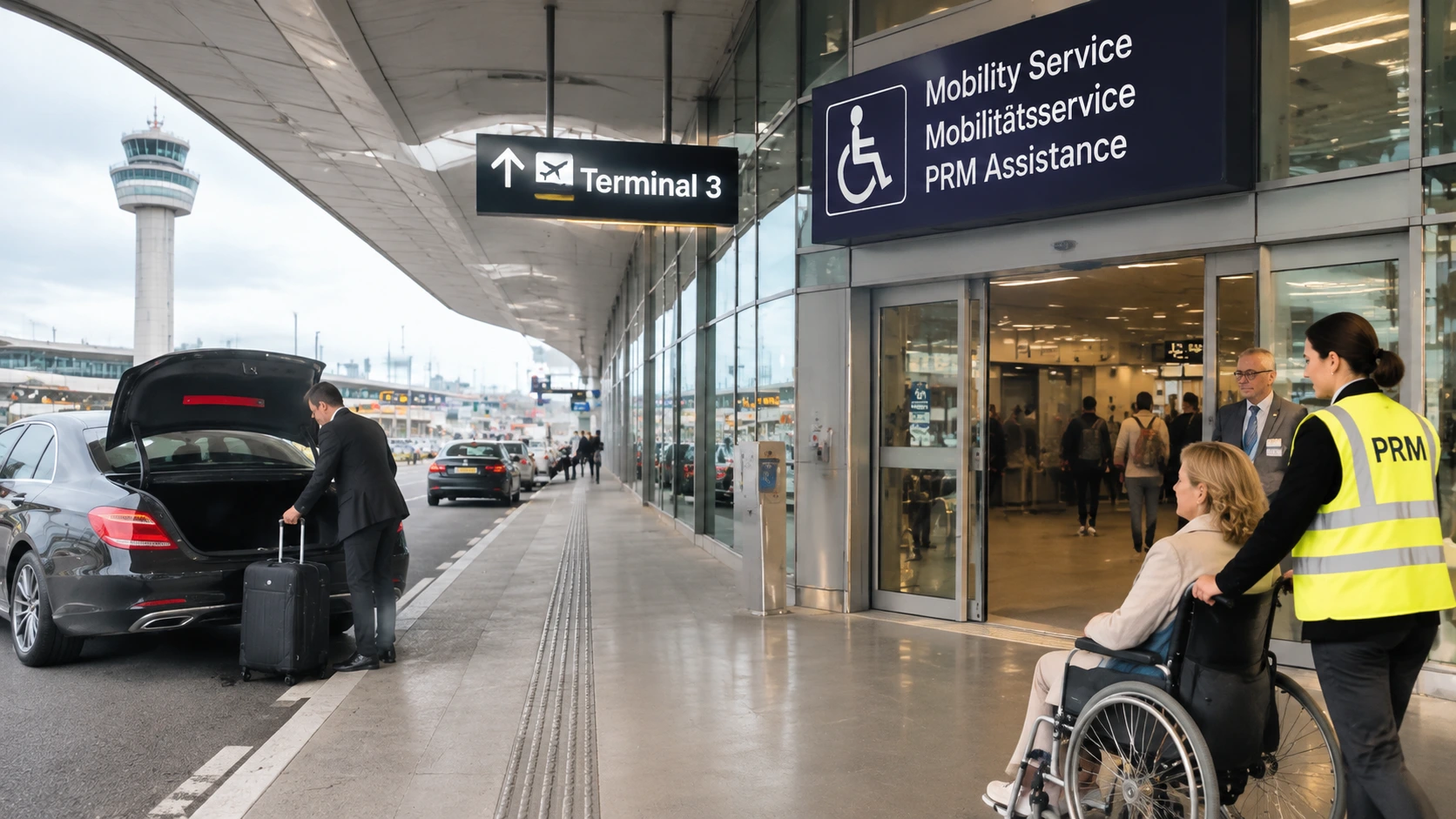
Quick Answer: Where Is the Mobility Service Desk at Vienna Airport?
Vienna International Airport (VIE), also known as Flughafen Wien-Schwechat, provides mobility assistance for passengers with reduced mobility and other accessibility requirements.
The airport's published directions identify the following assistance locations:
| Location | Where to find it |
|---|---|
| Terminal 1 | Next to the Airport Services counter |
| Terminal 3 Arrivals | Level 0 |
| Terminal 3 Departures | Level 1 |
Vienna Airport's detailed tactile-guidance document identifies two dedicated mobility service counters in Terminal 3, while its online directions also list the Terminal 1 Airport Services location.
Passengers arriving by ÖBB train can follow the airport's published tactile-guidance instructions towards the arrivals-level mobility counter. The City Airport Train (CAT), meanwhile, is temporarily operating with replacement buses.
Passengers arranging onward travel can also consider a pre-arranged private airport transfer. However, private transport and airport mobility assistance are separate arrangements.
Where Are the Vienna Airport Mobility Assistance Locations?
The correct reporting location depends on whether you are departing, arriving or approaching from the railway station.
Terminal 1 – Next to the Airport Services Counter
Vienna Airport lists an assistance location next to the Airport Services counter in Terminal 1.
Passengers using this terminal should look for Airport Services signage rather than assuming their airline's check-in counter provides PRM assistance.
The airport's online information identifies this location, while its detailed tactile-guidance document focuses on the two dedicated mobility service counters in Terminal 3.
If you are unsure where to report, ask Airport Services to confirm the current mobility assistance arrangements.
Terminal 3 – Arrivals, Level 0
One of the dedicated Terminal 3 mobility service counters is located on Level 0, the arrivals level.
This location is particularly relevant for passengers arriving by train who need to locate the airport's mobility assistance facilities.
The airport's tactile-guidance system provides designated routes from the railway platforms towards this counter.
Terminal 3 – Departures, Level 1
The second dedicated Terminal 3 mobility service counter is on Level 1, the departure level.
It can be reached from the upper-level taxi drop-off and accessible parking area by following the airport's designated tactile-guidance route.
The airport provides specific directions from the marked accessible parking spaces immediately after the police and fire department parking area.
The online airport directions list all three reporting locations. Passengers using Terminal 1 should confirm the exact reporting point with Airport Services if necessary.
How to Find the Mobility Service Desk from ÖBB Train Platforms
The ÖBB railway station, Flughafen Wien, is located on Level U2 beneath the main airport building.
It has a central platform serving tracks 1 and 2 and a separate side platform serving track 3.
Vienna Airport provides tactile floor information on the railway platforms. However, not every exit offers the same continuous guided route towards the arrivals-level mobility service counter.
From ÖBB Platforms 1 and 2
Tracks 1 and 2 share the central railway platform.
For passengers arriving from Vienna, the airport documents a step-free route through the U1 mezzanine using the elevator.
The general route is:
Leave the train and locate the tactile safety guide line.
Follow the designated route towards the elevator.
Take the elevator to Level U1.
After leaving the elevator, follow the tactile guidance through the vestibule with automatic sliding doors.
Continue towards the ascending ramp.
At Level 0, follow the guide line towards the mobility service counter.
The U1 mezzanine has continuous tactile floor information leading towards the arrivals-level counter.
If the elevator is unavailable: Vienna Airport also documents alternative routes involving stairs or an escalator. These are not step-free alternatives. Passengers who require wheelchair access should contact airport staff for an appropriate alternative rather than attempting stairs or escalators.
From ÖBB Platform 3
Platform 3 is a separate side platform used by both CAT and ÖBB services.
The airport's detailed tactile-guidance document includes a route from the former CAT train platform on track 3 towards the arrivals-level mobility counter.
Because these instructions are specifically presented under the CAT route, passengers arriving on an ÖBB service at track 3 should confirm the appropriate route with airport staff rather than assume that every instruction applies to their particular train exit.
The physical platform and its exits may be shared, but the current CAT replacement-bus service does not use the underground railway platform.
For detailed route information, consult the official Vienna Airport tactile-guidance instructions.
How Does the City Airport Train Replacement Bus Affect Mobility Assistance?
The City Airport Train (CAT) is temporarily operating with premium replacement coaches because of railway modernisation work.
The replacement-bus arrangement runs from 7 September 2026 through 31 October 2027.
At Vienna Airport, the buses depart from Terminal 3, Bus Bay 0.
Where Is the Current CAT Bus Stop?
Passengers should follow the current CAT signs to Terminal 3, Bus Bay 0.
The replacement-bus service is different from the former underground CAT train service.
This matters for passengers who use the airport's tactile-navigation instructions. The existing airport guidance document describes routes to the former CAT railway platform on Level U2. Those instructions should not be used to locate the current replacement bus.
Is the CAT Replacement Bus Accessible?
The CAT operator states that its replacement buses are not universally accessible.
Passengers with reduced mobility should contact CAT Customer Services in advance to confirm whether the service can accommodate their requirements.
CAT Customer Services: +43 1 25250
Passengers should not assume that the accessibility arrangements available on the former CAT trains also apply to the replacement coaches.
Check the official CAT replacement-bus information before travelling.
Is There Tactile Guidance to the CAT Replacement Bus?
Vienna Airport does not publish a dedicated tactile route to its general bus stops because changing stop locations make reliable barrier-free guidance difficult.
Passengers who need guided access to the current CAT bus stop should request directions from airport staff.
How Does Vienna Airport's Tactile Guidance System Work?
Vienna Airport uses tactile floor information to help passengers with visual impairments navigate selected areas of the airport.
The system uses specially designed floor surfaces to communicate route direction, junctions and important changes along a path.
It is particularly useful for passengers travelling between the railway platforms and the mobility service counter in Terminal 3.
Guide Lines and Attention Fields
The tactile guidance system includes different floor indicators that help passengers identify:
The direction of a designated walking route.
Changes in direction.
Junctions and crossing points.
Areas requiring additional attention.
Approaches to important entrances and facilities.
Passengers should follow the official route for their specific starting point because not all platform exits provide the same continuous tactile guidance.
Accessible Information at the Mobility Counters
Vienna Airport identifies several accessibility features at its mobility service counters:
Wheelchair-accessible service desks.
An inductive hearing system.
Sign-language video information.
Information panels with tactile writing.
Instructions explaining how to request assistance.
An intercom and telephone connecting passengers to the PRM control centre.
These facilities support passengers with different mobility, visual and communication requirements.
Additional Accessible Airport Facilities
Vienna Airport also provides accessibility facilities elsewhere in its terminals.
Its official information identifies:
Dedicated PRM and family security entrances in Terminal 1.
A wide accessible security entrance in Terminal 3.
Lowered self-service check-in kiosks.
Colour-coded illuminated airport signage.
Barrier-free washrooms for passengers with reduced mobility and families.
For further details, see the official Vienna Airport accessible facilities guide.
How to Reach the Terminal 3 Mobility Counter from Taxi Drop-off Areas
Vienna Airport publishes a specific tactile route from the accessible taxi drop-off and parking area on Terminal 3's upper level to the departure-level mobility service counter.
This route applies to the Terminal 3 departure area, not every taxi stop around the airport.
Accessible Taxi Drop-off on Level 1
The airport instructs taxi drivers to stop immediately after the police and fire department parking areas, in the spaces reserved for people with disabilities.
Passengers are then on Level 1, the Terminal 3 departure level.
Finding the Mobility Service Counter
The airport's documented route includes:
Locate the tactile guide line running parallel to the pavement.
Follow it towards the accessible entrance.
Identify the attention field in front of the entrance door.
Use the door-opening button positioned on the metal bracket to the right.
Continue inside along the tactile route.
Follow the changes in direction towards the mobility service counter.
The door-opening button is approximately 80 centimetres above the floor.
The call button and telephone receiver are positioned to the right of the mobility service counter.
What About the Arrivals-Level Taxi Rank?
The taxi stands and bus platforms are located on Level 0, close to the arrivals hall.
Vienna Airport does not publish a dedicated tactile route from these general bus and taxi stops to the mobility counter because changing bus-stop locations make reliable barrier-free route guidance difficult.
Passengers who need assistance from these areas should contact airport staff rather than rely on directions designed for the upper-level departure taxi area.
What If You Need Mobility Assistance Without a Prior Booking?
Passengers should ideally register their mobility requirements directly with their airline or travel agent when booking a flight.
Vienna Airport recommends notifying the airline at least 48 hours before departure. This allows the airline and airport assistance providers to prepare the necessary arrangements.
What If You Forgot to Request Assistance?
Passengers who have not registered their assistance requirements should not assume that help is unavailable.
For a departing flight, Vienna Airport instructs passengers to report to their airline's check-in desk. Staff can help coordinate the required assistance, although the process may take longer.
If you need assistance:
Locate your airline's check-in counter.
Explain the type of support you require.
Provide your flight details.
Tell staff whether you need help with airport navigation, boarding or onward movement.
Follow the instructions provided by the airline and airport assistance team.
Vienna Airport states that its PRM services are available around the clock and free of charge.
Registering at least 48 hours in advance remains the recommended approach.
Arranging a Private Transfer After Mobility Assistance
Airport mobility assistance and private airport transfers serve different purposes.
The PRM service supports passengers with reduced mobility during airport procedures, while a private transfer provides onward road transport to a hotel, home or another destination.
When arranging onward transport after receiving airport assistance, passengers and companions should consider a few practical requirements.
Coordinate the Transfer Around Mobility Assistance
Passengers receiving PRM assistance may need additional time to complete airport procedures or move between airport facilities.
When arranging onward transport:
Inform the transfer provider that the passenger has requested airport mobility assistance.
Allow sufficient time for the assistance process before confirming the expected pickup time.
Communicate any changes to the expected arrival or handover time.
Confirm whether additional support is required beyond ordinary passenger transportation.
This helps avoid confusion when the airport assistance process takes longer than expected.
Confirm Wheelchair and Mobility Aid Requirements
Before confirming a private vehicle, passengers should communicate:
Whether they use a manual or powered wheelchair.
Whether the mobility aid can be folded.
Its approximate dimensions and weight.
Whether the passenger can transfer independently into a standard vehicle seat.
How much space is needed for other luggage.
These details help establish whether the selected vehicle is suitable.
Can a Standard Chauffeur Vehicle Carry a Wheelchair User?
A standard chauffeur vehicle is not the same as a wheelchair-accessible vehicle.
Standard vehicles do not have dedicated wheelchair ramps or lifts and cannot accommodate a passenger travelling while seated in their wheelchair.
A passenger who can transfer independently into a vehicle seat may be able to travel with a folded wheelchair, subject to available luggage space and confirmation from the operator.
Passengers who need to remain seated in their wheelchair throughout the journey should arrange a suitably equipped wheelchair-accessible vehicle.
For information about standard vehicle arrangements, see the private airport transfer service.
The most important consideration is to confirm vehicle suitability before the journey rather than assume that airport mobility assistance automatically includes accessible onward transport.
For a broader explanation of airline terminal assignments and airport layout, see the separate Vienna Airport terminals guide.
The general Vienna Airport guide covers wider airport facilities and transport information.
Frequently Asked Questions
Where is the mobility service desk at Vienna Airport?
Vienna Airport lists an assistance location next to the Airport Services counter in Terminal 1, plus dedicated mobility service counters in Terminal 3 arrivals on Level 0 and departures on Level 1.
Is Vienna Airport mobility assistance available 24 hours?
Yes. Vienna Airport states that its PRM assistance services are available around the clock and free of charge.
How far in advance should I request wheelchair assistance?
Passengers should notify their airline or travel agent at least 48 hours before departure so the necessary assistance can be arranged.
What if I forgot to request mobility assistance before my flight?
Report to your airline's check-in counter immediately after arriving at the airport. Explain your requirements and ask the airline to coordinate PRM assistance. The process may take longer if assistance was not registered in advance.
How do I reach the mobility desk from ÖBB platforms 1 and 2?
The airport documents a tactile-guidance route through the U1 mezzanine. The step-free route uses the elevator to reach the mezzanine before continuing towards Level 0.
Can I follow the CAT platform directions from ÖBB platform 3?
Not automatically. Platform 3 is a shared side platform, and the airport's detailed instructions describe its route under the former CAT rail service. Passengers arriving on ÖBB at track 3 should confirm their exact accessible route with airport staff.
Is the CAT currently operating as a train?
No. From 7 September 2026 until 31 October 2027, CAT is operating with replacement coaches because of railway modernisation work.
Are CAT replacement buses wheelchair-accessible?
CAT states that its replacement buses are not universally accessible. Passengers with reduced mobility should contact CAT Customer Services on +43 1 25250 before travelling.
Does Vienna Airport have tactile floor guidance?
Yes. The airport provides tactile floor information on its railway platforms and designated routes towards mobility service counters.
What happens if the elevator is unavailable?
Vienna Airport publishes alternative routes involving stairs or escalators for some locations. These are not step-free alternatives. Passengers who require wheelchair access should contact airport staff for appropriate assistance.
Where can passengers with reduced mobility access security?
Terminal 1 has a separate PRM and family security entrance. Terminal 3 also has a wide accessible entrance for PRM and family passengers at boarding-pass control.
Can a standard chauffeur vehicle transport someone seated in a wheelchair?
A standard chauffeur vehicle should not be assumed to accommodate a passenger travelling while seated in their wheelchair. Passengers who need to remain in their wheelchair require an appropriately equipped accessible vehicle.
What is the difference between airport mobility assistance and a private airport transfer?
Airport mobility assistance supports passengers with reduced mobility during airport procedures, including check-in, security and boarding. A private airport transfer provides onward road transport from the airport to a confirmed destination. These are separate services and may need to be arranged independently.