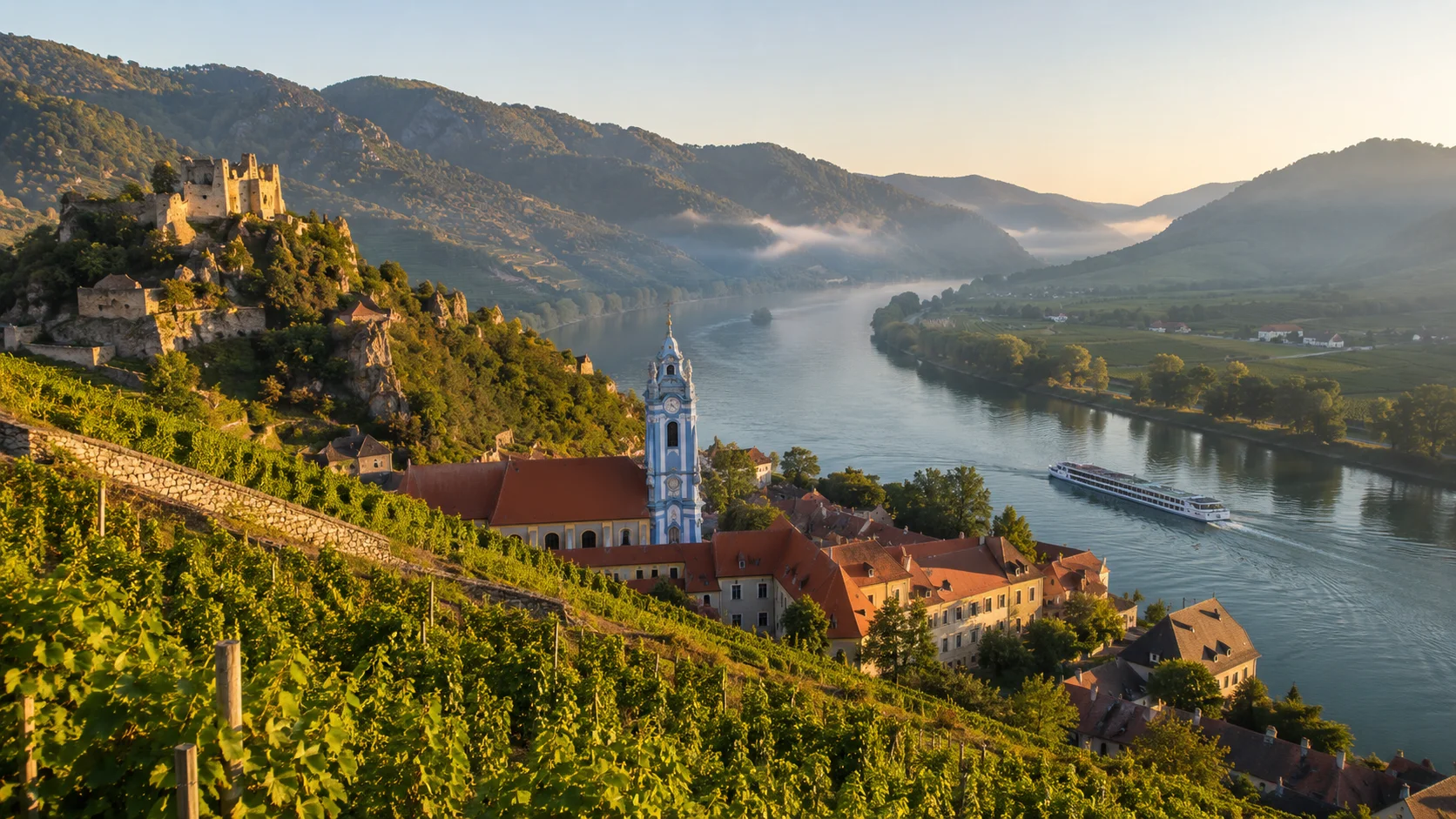
A Wachau Valley day trip from Vienna is one of the easiest escapes in Austria. The valley is a 36-kilometre stretch of the Danube between Melk and Krems. UNESCO has listed it as a World Heritage Cultural Landscape since 2000. Terraced vineyards climb both banks, medieval ruins sit above the water, and several towns worth stopping in are packed into that short distance. One day from Vienna covers the highlights comfortably, as long as the schedule does not try to squeeze in every stop. Melk Abbey, Dürnstein, and either Spitz or Krems make a realistic single day.
TL;DR
● The Wachau Valley is a UNESCO-listed Danube gorge between Melk and Krems, about 85 km west of Vienna.
● You can reach it by private car, group tour, ÖBB train, rental car, or the Donauradweg by bike.
● Plan a full day, roughly 8 to 9 hours door to door from Vienna.
● A private car is not tied to a train timetable or boat departure, which matters if the day runs long at one stop.
● Melk Abbey, Dürnstein, and Krems or Spitz are the core stops that most single-day itineraries share.
Vienna to Wachau Valley at a Glance
Here are the quick answers most travellers search for first when planning a Wachau Valley day trip from Vienna.
How Far Is Wachau Valley from Vienna?
The Wachau Valley lies about 85 km from Vienna by road to Melk, the valley's western entry point. Krems, at the opposite end, sits a few kilometres closer to Vienna depending on the route. Both towns are reachable within a single morning, whichever one anchors your day.
How Long Does It Take to Get from Vienna to Wachau Valley?
A private car or rental car covers Vienna to Melk in about one hour on the A1 motorway, traffic permitting. The direct ÖBB train from Vienna Hauptbahnhof or Westbahnhof to Melk takes roughly 50 to 60 minutes, similar to the drive. Trains to Krems run from a different station, Wien Franz-Josefs-Bahnhof, and take about an hour as well.
Can You Visit Wachau Valley in One Day?
Yes. A single day from Vienna is enough to see Melk Abbey, walk Dürnstein's old town, and pass through Spitz or Krems. The key is to start by mid-morning and avoid adding every village along the 36 km stretch.
When Is the Best Time to Visit Wachau Valley?
Late April through early October is the main season, when Danube cruises, most wineries, and outdoor terraces are open. April stands out for the apricot blossom, when the valley's Marillen orchards flower for about two weeks. The Wachauer Marille, the local apricot, even carries a protected origin label, and its fruit reaches market stalls and menus by mid-summer.
Fact | Answer |
Starting point | Vienna |
Destination | Wachau Valley (Melk to Krems, 36 km) |
Recommended duration | Full day (8 to 9 hours) |
Main highlights | Melk Abbey, Dürnstein, Spitz, Krems, the Danube, vineyards |
Transport options | Private car, group tour, public transport, rental car, bike |
UNESCO status | World Heritage Cultural Landscape since 2000 |
How to Get from Vienna to Wachau Valley
Five routes connect Vienna to the Wachau, and each suits a different kind of traveller.
Private Car with Driver
A private car with a driver picks up directly from your Vienna address and runs on a schedule you set, not a fixed departure time. The vehicle stays with your group at each stop, and pricing is per vehicle rather than per person. This is the model behind our private Wachau Valley day trip from Vienna, where one chauffeur handles the full route and the return journey. It works much like hourly chauffeur hire in Vienna, except the day is built around the valley rather than the clock.
Group Day Tour
A group day tour leaves Vienna at a set morning time from a central meeting point and follows a fixed itinerary with a guide. Lunch is usually at your own expense. Groups range from a handful of travellers in a minivan to a full coach.
Train and Public Transport
ÖBB operates the regional trains between Vienna and the Wachau, but the two ends of the valley use different Vienna stations. Trains to Melk leave from Wien Hauptbahnhof or Wien Westbahnhof via St. Pölten. Direct trains to and from Krems use Wien Franz-Josefs-Bahnhof, a separate station on the city's north side. That detail is worth knowing before you plan a one-way loop through the valley. You can check live departures on the ÖBB timetable.
Rental Car
A rental car gives you full control over timing and route. Economy models in Vienna typically start around €30 to €60 per day, depending on season. Austrian motorways also require a toll vignette for the A1 to Melk. Driving does rule out wine tasting for whoever is behind the wheel back to Vienna.
Cycling the Donauradweg and EuroVelo 6
The Donauradweg, part of the EuroVelo 6 long-distance route, runs flat along the Danube for the full 35 km between Melk and Krems. Bike rental is available at both ends. A one-way ride paired with a train back is the most common plan.
Which Option Is Best for You?
The right option depends mainly on group size, budget, and how much the day needs to flex. Couples and families tend to prefer a private car. Solo travellers and budget groups often choose the train or a group tour. Cyclists care more about the ride itself than the number of stops.
Feature | Private Car | Group Tour | Train or Bus | Rental Car | Bike |
Hotel pickup | Yes | Depends | No | No | No |
Privacy | Yes | No | No | Yes | Yes |
Flexible stops | Yes | Limited | Limited | Yes | Limited |
Driving required | No | No | No | Yes | No |
Planning effort | Low | Low | High | Medium | Medium |
Best for | Couples and families | Budget and social travellers | Independent travellers | Confident drivers | Active travellers |
Best Places to Visit in Wachau Valley
Once you have chosen how to travel, the next question is where to stop.
Melk Abbey
Melk Abbey, known locally as Stift Melk, is the Benedictine monastery that overlooks the town from a rock terrace above the Danube. It is why most Wachau day trips start here. A monastery has stood on the site since 1089, when the Babenberg margrave Leopold II gave it to Benedictine monks. The current Baroque complex dates from a reconstruction under architect Jakob Prandtauer between 1702 and 1736. Plan 1.5 to 2 hours for the abbey church, terrace, and library, which holds around 100,000 volumes. Johann Michael Rottmayr painted the church's ceiling frescoes, while Paul Troger painted those in the library and the Marble Hall. Napoleon reportedly used the abbey as a base during his campaigns against Austria in 1805 and 1809. Check current opening hours on the official Melk Abbey site before you visit.
Dürnstein
Dürnstein's defining feature is the ruined castle above the town. This is where Richard the Lionheart was held prisoner in 1192 and 1193, after quarrelling with Duke Leopold V of Austria on his return from the Third Crusade. The climb takes roughly 20 to 30 minutes and rewards you with a view down the river both ways. Below it, the old town is a single main street of Baroque facades and the blue-and-white tower of the Stiftskirche. You can walk it in under an hour.
Spitz and Weissenkirchen
Spitz and Weissenkirchen are two wine villages a few kilometres apart. Each is worth a short stop rather than a long one. Spitz sits below the Tausendeimerberg vineyard, with a compact old town along the water. Weissenkirchen is known for its fortified, twin-towered parish church, built partly for defence during Ottoman incursions. Apricot orchards surround both, in blossom in spring and heavy with fruit by mid-summer.
Krems
Krems an der Donau anchors the eastern end of the valley as its largest town. Its historic core is built around the Landstraße pedestrian street. The Steiner Tor, a 15th-century town gate, marks the boundary between Krems and the neighbouring district of Stein. The Kunstmeile Krems adds a cluster of galleries, including the Kunsthalle Krems and the Karikaturmuseum. The latter is Austria's dedicated museum of caricature and satirical art. Together they give the town a contemporary art scene the smaller villages do not have.
The Danube and Wachau Vineyards
The Danube shapes the entire Wachau. The river cuts a narrow gorge between Melk and Krems. The terraced vineyards on both banks exist for one reason: the slopes and water together create a microclimate suited to wine grapes. Stone terrace walls, some centuries old, hold the vines on gradients too steep for machinery. The valley's UNESCO World Heritage listing covers exactly this combination: a working agricultural landscape, not a site preserved in amber.
Scenic Stops and Viewpoints
Aggstein Castle is a medieval clifftop ruin high above the river. It is visible from the water on a Danube cruise, but easy to miss if your day only covers Melk, Dürnstein, and Krems. It sits roughly midway along the valley, reachable by a short detour off the main road. Other worthwhile pull-offs include the viewpoint above Dürnstein and the riverside promenade in Spitz.
More Wachau Stops Worth Knowing
The classic three cover most of the valley, but a few more places reward extra time or a return visit.
Göttweig Abbey
Göttweig Abbey, or Stift Göttweig, sits on a hilltop above the eastern edge of the valley near Krems. The Benedictine monastery stands at 422 metres and is visible for miles, which earns it the nickname the Austrian Montecassino. It was founded in 1083 and rebuilt in High Baroque style after a fire in the early 18th century. The Imperial Staircase carries a ceiling fresco by Paul Troger, the same artist who painted the library at Melk. Its terrace restaurant and abbey park look straight out over the Danube and the vineyards. The abbey museum is open from spring to autumn. You can plan a visit through the official Göttweig Abbey site. Adding it works best as a custom private tour, since it sits just off the main valley route.
The Venus of Willendorf
The Wachau holds one of the most famous archaeological finds in the world. The Venus of Willendorf, a small limestone figurine about 29,500 years old, was unearthed at the village of Willendorf in 1908 during railway construction. It stands only 11 centimetres tall and was carved from a stone not found in the region. The original now sits in the Natural History Museum in Vienna, though the find spot lies in the valley between Aggsbach and Spitz. For history-minded travellers, it is a striking reminder that people have lived along this stretch of the Danube for tens of thousands of years.
Schönbühel Castle
Schönbühel Castle perches on a rock at the water's edge just east of Melk. Known as the Watchman of the Wachau, it marks the start of the scenic gorge as you enter from the Melk end. The castle is private and closed to visitors, but it is one of the most photographed sights on the drive and on the Danube cruise.
The Best Wachau Valley Day Trip Itinerary from Vienna
Here is how a well-paced private Wachau day trip runs, hour by hour.
Morning: Vienna Pickup
The day starts with an early departure, ideally by 8:00 to 8:30 AM, to reach Melk before the mid-morning tour groups arrive. In our experience, that first hour on the road is what makes or breaks the day at the abbey. A private car allows pickup from your hotel or apartment address rather than a central meeting point.
Melk Abbey
Melk Abbey comes first, timed for the 1.5 to 2 hours described above. Arriving early means quieter cloisters and an easier photo from the terrace.
Scenic Drive Through the Wachau Valley
From Melk, the road hugs the river's south bank through Schönbühel and Aggstein before crossing toward Dürnstein. Vineyard terraces line the route the entire way. A private car has a real advantage here, because it can stop at any viewpoint without doubling back.
Dürnstein
Dürnstein follows, with time for the old town and, for anyone up for the climb, the castle ruins described earlier.
Optional Danube Cruise
DDSG Blue Danube runs scenic cruises on this stretch between April and October. A typical leg covers Melk to Dürnstein or Krems in under two hours downstream, on a fixed schedule. A private driver can meet the boat at a different dock from where it departed. That removes the need to plan the rest of the day around one departure time. You can check DDSG Blue Danube schedules for current sailings.
Optional Wine Experience
A tasting stop fits naturally into the afternoon, usually in Dürnstein, Spitz, or the villages between. Group tours schedule this at a set time and place. A private car can add it wherever it fits the day.
Return to Vienna
The return retraces the outbound route. Most days that start around 8:00 AM are back in Vienna by early evening.
Three Ways to Customize Your Day
● Classic: Melk Abbey and Dürnstein only, with time to properly explore both.
● Relaxed: fewer stops overall, more time at scenic viewpoints along the drive.
● Experience: sightseeing paired with a wine tasting, a Danube cruise, or both.
If none of these fit, you can build a custom private tour around the exact stops you care about.
Common Wachau Day Trip Mistakes
1. Expecting boats to run in winter. The Danube cruise season ends in October. Regional bus 715 on the north bank and bus 720 on the south bank cover the Melk to Krems route year-round instead. For a car-free plan, the Wachau day ticket bundles the buses and Danube ferries.
2. Trying to see too many villages in one day. Melk, Dürnstein, Spitz, Weissenkirchen, and Krems in a single afternoon leaves no real time at any of them.
3. Driving after wine tasting. A rental car and a winery stop do not mix for the driver. A private driver removes this problem entirely.
4. Skipping Melk Abbey to save time. It is the anchor of most itineraries for a reason, and cutting it usually saves less time than expected.
How Much Does a Wachau Valley Day Trip from Vienna Cost?
The cost of a Wachau Valley day trip from Vienna varies widely by how you travel. Here is a realistic breakdown per option.
Group Tour Cost
Standard group day tours from Vienna typically range from €60 to €150 per person. Wine-tasting or full-cruise tours run higher, sometimes above €200.
Train and Public Transport Cost
A one-way ÖBB ticket from Vienna to Melk or Krems runs roughly €15 to €25. A self-planned round trip therefore costs about €30 to €50 per person, before attraction tickets.
Rental Car Cost
An economy rental car in Vienna typically starts around €30 to €60 per day. Add fuel and the Austrian motorway vignette required for the A1.
Private Car Cost
An 8-hour private Wachau excursion with TourlyTransfer starts from updated price €450. The price is fixed per vehicle rather than per person, and the return journey to Vienna is included. For a couple or a family, that often lands close to the per-person cost of a guided group tour, with none of the fixed schedule. You can see the exact figure for your dates on our Wachau Valley day trip page.
Additional Costs to Consider
Melk Abbey entry runs about €17 to €22. A DDSG Blue Danube one-way cruise between Melk and Krems costs roughly €28 to €37. A winery tasting typically adds €10 to €25 per person on top of transport. Added together, a fully self-planned day combining the round-trip train, Melk Abbey, and the boat runs roughly €75 to €110 per person before food.
Option | Typical cost | Basis |
Group tour | €60 to €150+ per person | Per person, guide included |
Train (round trip) | €30 to €50 per person | Per person, before attraction tickets |
Rental car | €30 to €60 per day | Per vehicle, plus fuel and vignette |
Private car | From €334 | Per vehicle, return journey included |
What Does a Private Wachau Valley Car Trip Include?
Our private Wachau day trips are built around four things: comfort, flexibility, family logistics, and pre-arranged extras.
Comfort covers the basics of the day. That means door-to-door pickup and drop-off at your Vienna hotel or apartment, an English-speaking driver, bottled water in the vehicle, and Wi-Fi or a phone charger for the ride. None of this needs advance coordination beyond confirming the pickup address and time the night before.
Flexibility is what separates a private car from a group tour or train. The route and timing can shift mid-day. You might spend longer in Dürnstein, add a detour to Aggstein Castle that a fixed tour would skip, or make an unplanned photo stop along the river. The driver waits at each location rather than working to a set return time, so nobody watches the clock to make a departure.
Family logistics matter with young children. You can request child seats in advance, and the driver handles luggage directly. That avoids the platform transfers and station changes that public transport between Melk and Krems involves. Larger groups travel together in a Mercedes-Benz V-Class van rather than splitting across vehicles.
Pre-arranged extras go beyond the driving. Restaurant recommendations, a winery visit worked into the route, a DDSG Blue Danube cruise, or Melk Abbey tickets can all be built into the plan ahead of time. Nothing needs separate booking once the trip is underway. You can shape your own route through Melk, Dürnstein, and Krems and get a fixed quote for the full day, which covers the vehicle regardless of group size.
Practical Tips for Your Wachau Day Trip
A few practical details make a Wachau Valley day trip from Vienna smoother, whether you drive yourself or travel with a driver.
Where to Park in Melk, Dürnstein and Krems
Melk has a large car park a short walk from the abbey. Dürnstein is the tight spot, with limited parking that fills quickly on summer weekends. The usual approach is to park in the village car parks and walk in, or to arrive early. A private driver avoids the problem, because the car drops you at the entrance and parks separately.
Melk Abbey Tickets and Opening Times
Melk Abbey opens daily from spring to autumn, with shorter hours and guided-tour-only access in winter. In peak summer and on weekends, buying tickets online ahead of time saves queueing. A guided tour runs to a set start time, so build it into the schedule rather than arriving on spec.
What to Wear and Bring
Comfortable shoes matter more than anything else. The old-town lanes are cobbled and the castle climb above Dürnstein is steep. Bring sun protection for the exposed vineyard terraces in summer, and a light layer for the breeze on the river if you take a cruise.
Cash, Cards and Tipping
Melk and Krems handle card payments without trouble. The smaller villages, wine taverns and market stalls often prefer cash, so carry some euros for the day. Tipping is modest in Austria. Rounding up or adding around five to ten per cent in a restaurant is normal, and a small tip for a good driver is appreciated but not expected.
Accessibility
Melk Abbey offers step-free access to much of the complex, though parts involve stairs. Dürnstein's cobbled lanes and castle path are harder going for anyone with limited mobility. A Danube cruise and the abbey terraces are the most accessible ways to enjoy the valley.
Wachau Valley Wine Tour from Vienna
Wine is a large part of why people take a Wachau day trip, so it deserves its own plan.
Why Is Wachau Famous for Wine?
The Wachau is known for Grüner Veltliner and Riesling, two white varieties that thrive on the valley's steep, south-facing terraces and rocky, mineral-rich soil. The river moderates temperatures enough to let grapes ripen fully while keeping the acidity that defines the regional style. Many growers pour their own wine at a Heuriger, the traditional Austrian wine tavern, marked by a bundle of straw or pine hung above the door.
Understanding the Vinea Wachau Classification
Vinea Wachau, the growers' association founded in 1983, sorts wines into three tiers by ripeness and style rather than price. Each name has a specific origin. Steinfeder takes its name from a wispy grass that grows on the stone terraces. Federspiel refers to the lure a falconer uses to call a hawk back. Smaragd is named for the emerald-green lizards that sun themselves on the same terrace walls.
Category | Style | Alcohol |
Steinfeder | Light, young, picnic-style wines | Up to 11.5% |
Federspiel | Medium-bodied, food-friendly | Up to 12.5% |
Smaragd | Full-bodied, ageable | 13% and above |
Named Wachau Wineries to Know
Domäne Wachau, Nikolaihof, Emmerich Knoll, and Franz Hirtzberger are among the region's established producers. Each works vineyards along the valley's steepest terraces. Tastings typically run 30 to 60 minutes.
Wine Tasting vs Sightseeing
Wine tasting and sightseeing compete for the same afternoon hours. A day built around both usually means less time at any single stop. Travellers who want an unhurried tasting are better off dedicating the afternoon to one winery rather than splitting it with a full town visit.
Can You Combine Wine Tasting with Melk and Dürnstein?
Yes, though the day runs long. A realistic version covers Melk Abbey in the morning, Dürnstein around midday, and a single winery stop in the afternoon. That is three destinations rather than the full village list.
Who Should Choose a Wine-Focused Wachau Trip?
A wine-focused trip suits travellers who would rather taste properly at one or two estates than tick off every town. It works best as a private trip, where the itinerary can be reordered around tasting appointments and a driver covers the road back.
What to Eat and Drink in the Wachau
Food in the Wachau follows the same two themes as the landscape: wine and apricots.
Wachau Apricots and Marillen Specialities
The Wachauer Marille, the region's protected apricot, is the local speciality. During the July harvest it turns up everywhere, in Marillenknödel (apricot dumplings), Marillenschnaps (apricot brandy), jams, cakes and liqueurs. Dürnstein in particular has shops devoted to apricot products, which make easy souvenirs. The fruit is smaller and more intensely flavoured than the supermarket kind.
Local Dishes and the Heuriger
Beyond apricots, look for the Wachauer Label, a crusty regional bread roll, alongside hearty Austrian classics. The most characterful place to eat is a Heuriger, a seasonal wine tavern run by a grower and marked by a branch hung above the door. These serve the estate's own wine with cold platters of cured meats, cheese and spreads. In autumn, many pour Sturm, the cloudy, partly fermented young wine that appears only for a few weeks.
Wachau Valley by Season and Events
The best season for a Wachau Valley day trip from Vienna depends on what you want, and a few dates are worth planning around.
Spring
Late March into April brings the apricot blossom, when the orchards flower for roughly two weeks. The Wachau Gourmet Festival in spring draws chefs and wine lovers to Dürnstein. Vineyards are fresh and green, and crowds are lighter than in summer.
Summer
Summer is peak season, with cruises running and long daylight. July is apricot month. The Spitzer Marillenkirtag, held on the second-to-last weekend of July since 1951, fills the church square in Spitz with apricot stalls, music and a famous dumpling machine. Krems runs its own apricot festival, Alles Marille, earlier in the month.
Autumn
Autumn brings the grape harvest and golden vineyard colours. This is the season for Sturm and for the wine-hiking days, when growers open tasting stations along the terraces. The valley is quieter than midsummer but still lively at weekends.
Winter
Winter is the quietest time. Danube cruises pause from November to March, and some restaurants and wineries close or cut their hours. Melk Abbey stays open with winter timings, and small Advent markets appear in Dürnstein, Krems and at Göttweig Abbey in the weeks before Christmas.
Which Wachau Day Trip Is Right for You?
The best Wachau day trip from Vienna looks different for each traveller. Here is the short version.
Best for Couples
Couples do best with a private car for privacy and the freedom to change the plan on the day. A shared tasting and a slow lunch beat a coach timetable.
Best for Families
Families do best with a private car for the child seats, the luggage handling, and the option to shorten a stop when a young child has had enough.
Best for Small Groups
Groups of three to seven travel well together in a private vehicle. That avoids the split-up a train journey or coach tour can involve.
Best for Wine Lovers
Wine lovers benefit from a wine-focused private trip, where the itinerary can prioritise one or two wineries over a full sightseeing list.
Best for Budget Travellers
Budget travellers are usually better served by the train or a standard group tour. Both cost less per person than a private vehicle for a solo trip.
Traveller | Best option | Why |
Couples | Private car | Privacy and flexibility |
Families | Private car | Door-to-door and child seats |
Small groups | Private car | Stays together |
Wine lovers | Wine-focused private trip | Flexible itinerary |
Budget travellers | Group tour or public transport | Lower cost |
Frequently Asked Questions
Is Wachau Valley Worth Visiting from Vienna?
Yes. The Wachau combines Melk Abbey, a UNESCO-listed river landscape, and the medieval town of Dürnstein, all within about an hour of Vienna.
Can You Visit Melk and Dürnstein in One Day?
Yes, and it is the most common version of the trip. The two towns are roughly 30 to 40 minutes apart by road.
Is Wachau Valley Possible Without a Car?
Yes. ÖBB trains reach both Melk and Krems directly from Vienna. Within the valley, a DDSG cruise, regional buses 715 and 720, or the seasonal Wachaubahn heritage railway between Krems and Emmersdorf all cover the gap between towns.
Is a Private Car Worth It for Wachau?
It is worth it for travellers who prioritise flexibility, or for a group that wants to stay together. It costs more than the train, but it removes the schedule constraints public transport carries.
What Happens If It Rains?
Melk Abbey and the Kunstmeile Krems galleries both work as indoor options. Dürnstein's old town and castle climb are manageable in light rain, but less appealing in a downpour.
How Many People Can Travel in a Private Car?
A business sedan seats up to three passengers with luggage. Larger groups can request a Mercedes-Benz V-Class, which takes up to seven.
Does the Wachau Boat Run Year-Round?
No. The cruise season is April through October. Outside those months, the regional buses and trains cover the same route.
What Is the Vinea Wachau Wine Classification?
Vinea Wachau sorts the region's wines into three tiers by ripeness: Steinfeder, Federspiel, and Smaragd.
Is Wachau Family-Friendly?
Mostly yes. A Danube boat ride suits kids well. Melk Abbey's tour can feel long for young children, and the castle hike above Dürnstein needs supervision given the drop-offs.
Is It Crowded?
Dürnstein gets busy on summer weekends and around midday, when tour buses and cruise passengers overlap. Weekdays and mornings are calmer.
Do You Need to Book Melk Abbey Tickets in Advance?
In quiet periods you can buy on arrival. In peak summer, on weekends, and for a guided tour at a set time, booking online ahead saves queueing.
Where Can You Park in Dürnstein?
Parking is limited and fills on summer weekends. Use the village car parks and walk in, arrive early, or travel with a driver who drops you at the entrance.
What Food Is the Wachau Known For?
The Wachau is known for Grüner Veltliner and Riesling wine, and for apricots. Look for Marillenknödel, Marillenschnaps, apricot jams, and the local Wachauer Laberl bread roll.
Should I Bring Cash or Cards?
Melk and Krems take cards easily. Smaller villages, wine taverns and market stalls often prefer cash, so carry some euros for the day.
Do You Tip Drivers and Guides in Austria?
Tipping is modest and not mandatory. Rounding up or adding five to ten per cent in restaurants is normal, and a small tip for a good driver is appreciated.
Is One Day Enough, or Should You Stay Overnight?
One day covers Melk, Dürnstein and Krems comfortably. An overnight suits wine lovers, keen walkers, or anyone who wants a slower pace.
Should I Choose the Wachau, Hallstatt or Salzburg?
The Wachau is the closest and easiest, at about an hour from Vienna. A Hallstatt day trip or a Salzburg day trip runs longer but adds lake or city scenery, so the right pick depends on your time and interests.
Book a Private Wachau Valley Day Trip from Vienna
Choose Your Preferred Itinerary
Classic, relaxed, or wine-and-cruise: the options above can all be adjusted to your day. Plan around what you actually want to see rather than a fixed template.
Check Availability
Vehicles and drivers are confirmed by date, so it is worth checking early for peak months like July, August, and the April blossom weeks. Check availability for your travel dates before you finalise the rest of the trip.
Request a Private Quote
Our pricing keeps the vehicle fixed for the day, covering pickup, the full route, and the return to Vienna. Request a fixed price for your Wachau day to see the exact cost before booking.
TourlyTransfer is a licensed Vienna passenger transport operator running a Mercedes-Benz fleet with fixed, per-vehicle pricing. The Wachau pairs naturally with the rest of our Vienna chauffeur service. If you have more time in Austria, a day trip to Hallstatt and the Salzburg day trip both follow the same A1 motorway west. You can browse all our private day trips from Vienna or read more Vienna travel guides for ideas.